ViDock External Thunderbolt PCI Expansion Chassis and Hub in Development - MacRumorsOpen MenuShow RoundupsShow Forums menuVisit ForumsOpen Sidebar
Skip to Content

ViDock External Thunderbolt PCI Expansion Chassis and Hub in Development

ViDock34open
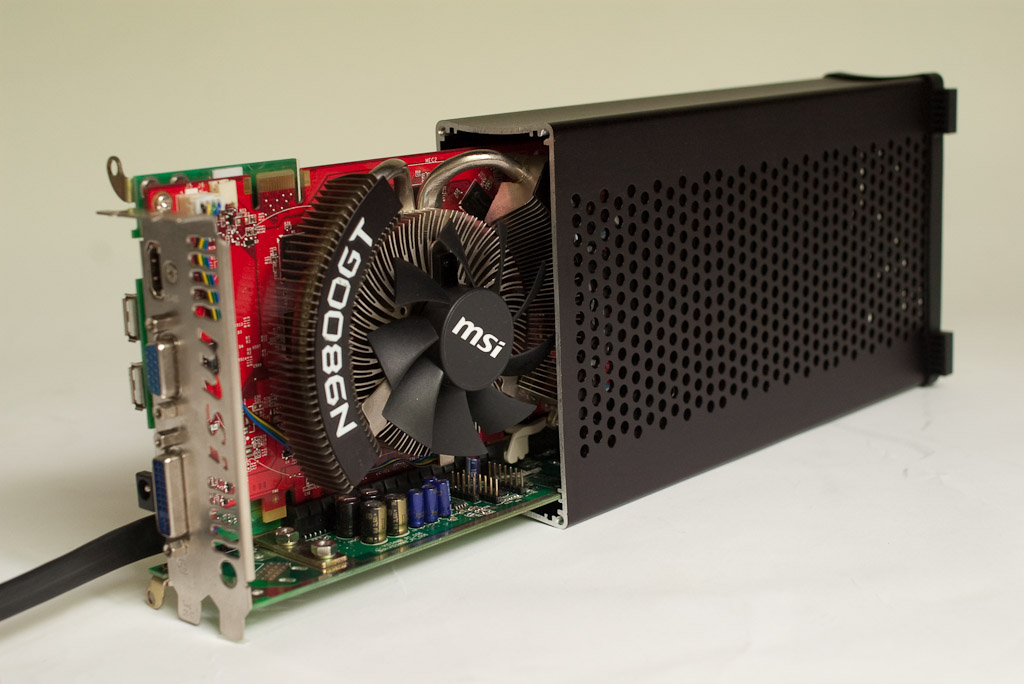
Current generation ViDock

VillageTronic has started work on a Thunderbolt version of its ViDock PCI expansion chassis that allows laptop owners to use PCI Express graphics cards on their computers. They lay out the following usage scenario:

ViDock2Spider34

Imagine using your thin and light laptop PC during the day on the job, at school, or at the local café then arriving home, or dorm room, plugging it into your ViDock and firing up your latest PC game on a large format monitor. Just plug in one cable into your laptop PC and you instantly have a powerful 3D workstation with a big display, a big keyboard and your pointing device of choice. You are ready for gaming, video transcoding, photoshop, 3D design, watching full 1080p HD movies, and more!

The ViDock presently interfaces through laptops using an ExpressCard slot, but we've heard that development has started on a Thunderbolt compatible version. ExpressCard slots are a rarity on Apple's laptops, presently only available on the 17" MacBook Pro. By offering a Thunderbolt version of this expansion chassis, even 11" MacBook Air customers could theoretically drive an external graphics card.

Villiagetronic originally posted a feeler for such a device on their Facebook page, promising to pursue development if there was enough interest. They've also discussed the possibility of adding USB ports, Ethernet and other ports to the expansion dock. Separately, we've heard the chassis itself will adopt an aluminum "Mac" look, unlike the presently shipping ViDocks (pictured above).

Sony had previously introduced a similar but proprietary dock system for their upcoming ultra-thin 13" notebook. It's no surprise that companies are starting to work on similar solutions for the broader market, and Villiagetronic isn't alone with a similar Sonnet device also having been announced.


Popular Stories

macOS 27 on MacBook Pro

Apple Says macOS 27 Won't Be Compatible With These Macs

Wednesday June 3, 2026 8:29 am PDT by
During WWDC 2025, Apple revealed that macOS 26 Tahoe would be the final major macOS version for Intel-based Macs. macOS 27 will be compatible with Apple silicon Macs only, meaning that you will need a Mac with an M-series chip or a MacBook Neo with an A18 Pro chip in order to install the software update. Apple will unveil macOS 27 during its WWDC 2026 keynote this Monday, June 8, and the...
MacBook Neo on Yellow Feature

MacBook Neo is So Popular That Apple Reportedly Doubled Production

Wednesday June 3, 2026 9:24 am PDT by
On an earnings call in late April, Apple's CEO Tim Cook said that customer response to the MacBook Neo was "off the charts," and the popularity of the laptop has reportedly led the company to significantly boost production. Apple supply chain analyst Ming-Chi Kuo this week said he believes that MacBook Neo shipments to Apple were doubled from an initial target of 5 million units to 10...
iphone 18 pro blue%402x

iPhone 18 Pro: Dark Cherry, Light Blue, and Dark Gray Chassis Leaked [Update]

Thursday June 4, 2026 5:18 am PDT by
Update: Since publication, new information has come to light suggesting the images have been AI-manipulated and are not in fact iPhone 18 Pro chassis parts. The original article follows. The color options Apple is reportedly planning for the upcoming iPhone 18 Pro and ‌iPhone 18 Pro‌ Max have appeared online today in the form of images of chassis parts of unknown authenticity....

Top Rated Comments

gnasher729 Avatar
194 months ago
Exactly. Didn't this idea get discussed and sunk a few weeks ago? Apparently TB doesn't provide enough bandwidth for a top end graphics chip.

However, could it work if the graphics chip only needs to send its output directly on to the display? I don't know about the electronics necessary here at all - pure speculation on my part.

Do you normally go: Processor>Graphics chips>Processor>Graphics chips>Display?

Or just: Processor (data) >Graphics (draw)>Display?

Apparently lots of people talk a lot without knowing much what they are talking about. While high end graphics cards can use 16 PCI lanes instead of the four the Thunderbolt provides, that doesn't mean they actually improve performance. PCI lanes are only used for sending textures and commands to the graphics card. Giving the graphics card plenty of video RAM avoids having to resend textures, and Thunderbolt is still tons faster than the hard drive that these textures are read from. And you don't send _that_ many commands to the graphics card, especially with physics on the card. And what makes a high end card really high end is the amount of pixelshader code that it can run, and that is completely on the card and doesn't go over Thunderbolt at all.

And the normal case is that a graphics card sends data directly to the display. So an external card could have a DVI or HDMI adapter, or Displayport, or even Thunderbolt so that you can attach two displays, but not connected back to the main computer. It basically works exactly the same as any old graphics card that you buy and put into a MacPro or a desktop PC.
Score: 4 Votes (Like | Disagree)
194 months ago
Thats a cool idea. Wouldn't surprise me if Apple themselves have played around with the idea too.

would love to see this on thunderbolt displays. it would actually influence me to buy one.

Think of the new Apple Thunderbolt Display if Apple put a monster GPU in the display and when you dock your MacBook Air it turbo charges it with a beautiful display and ports already there! This sounds like a logical progression for mobile computing coexisting with power users! :cool:
Score: 4 Votes (Like | Disagree)
res1233 Avatar
194 months ago
...if the drivers for Lion exist, which they probably won't. Also depending on the power supply the true high-end graphics cards might not get enough juice.
I'd imagine anything like this would have to come with its own power supply to be viable in the first place, so I wouldn't worry.

P.S. So now you people understand why some of us see a bright future for thunderbolt. Buy yourself a low-end mac mini, then get yourself one of these babies, and presto! A gaming PC. All we need now is for AMD/NVidia to start provide their own drivers, then we'd be all set. I wonder if NDIS could be ported to Mac OS?
Score: 4 Votes (Like | Disagree)
iSayuSay Avatar
194 months ago
" ... Imagine using your thin and light laptop PC during the day on the job, at school, or at the local café then arriving home, or dorm room, plugging it into your ViDock and firing up your latest PC game on a large format monitor. Just plug in one cable into your laptop PC and you instantly have a powerful 3D workstation with a big display, a big keyboard and your pointing device of choice. You are ready for gaming, video transcoding, photoshop, 3D design, watching full 1080p HD movies, and more! ..."
Yeah .. imagine that Thunderbolt naysayers ... Can USB 3.0 do that? :D
Score: 4 Votes (Like | Disagree)
Hellhammer Avatar
194 months ago
The Sonnets come with 150W or 75W power supplies. The Radeon HD 6970 requires about 360W (http://www.guru3d.com/article/radeon-6950-6970-review/11). So, as I said- the high end graphics cards will still be out of reach unless they decide to stick a rather large PSU on the back of those things.

Of course, not everyone will need the best of the best. I imagine for most people the bay PSU will suffice for whatever they want to put in it.

That is the wattage the whole system is using, not the power consumption of the GPU (it can't really be measured separately). 6970 has TDP of 250W while the Sonnet and ViDock provide up to 225W (150W PSU + 75W PCIe).
Score: 3 Votes (Like | Disagree)
194 months ago
not enough bandwith in thunderbolt yet. Thunderbolt = 4x PCIe. Modern video cards use 16x PCIe.
Please see the multiple posts in this thread disputing this fact. Its annoying when people spread information that is not correct. To summarize, modern GPUs support 16x but do not utilize that potential bandwidth except for the highest end cards. Even then, 4x is enough to get over 90% of the potential out of the highest GPUs so this implementation could greatly benefit those who are willing to pay for the option.
Score: 2 Votes (Like | Disagree)