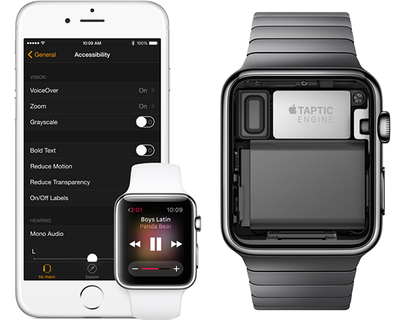
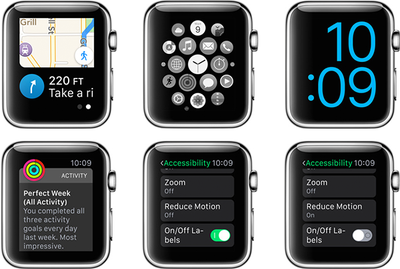
Apple has outlined the Apple Watch's built-in accessibility features for vision and hearing on its website, with four of the primary assisitive technologies being VoiceOver, font adjustment, mono audio and the Taptic Engine. The accessibility features can be accessed using the Apple Watch directly or through the Settings app on a paired iPhone.
For the visually impaired, the Apple Watch features VoiceOver, a gesture-based tool that uses the device's built-in speaker to communicate what is appearing on the screen. VoiceOver is compatible with built-in apps and available in 14 supported languages. Apple Watch users can also activate Larger Dynamic Type to adjust the size of the font or choose Bold Text to make the text heavier.
Apple outlines six other assistive technologies for the visually impaired: zoom, grayscale, extra large watch face, reduce transparency, on/off labels and reduce motion. Zoom is controlled using the Digital Crown on the side of the Apple Watch, while the other accessibility features must be enabled through settings.
Apple Watch also supports mono audio for people that are deaf or have hearing loss in one ear, enabling users to play both audio channels in both ears and adjust the balance for greater volume in either ear. Apple Watch also features the Taptic Engine for haptic feedback, giving your wrist a gentle tap every time a notification comes in.
Bloomberg's Mark Gurman has high expectations for Apple's first foldable iPhone.
In his Power On newsletter today, he said the foldable iPhone will be "the most significant overhaul in the iPhone's history."
"iPhone 4, iPhone 6 and iPhone X were clearly a big deal, but this is a whole new design," he said.
Like Samsung's Galaxy Z Fold 7, the foldable iPhone will reportedly open up like ...
iOS 26.5 is now available for developers, and while it doesn't include any new Siri capabilities, there are some major changes for the European Union, and smaller tweaks for features available worldwide.
Suggested Places
In the Maps app, there's a new "Suggested Places" feature that recommends locations to visit based on trending places nearby and recent searches. When Apple launches ads in ...
Apple has been celebrating its upcoming 50th anniversary by hosting surprise performances and other events around the world over the past few weeks, and now Bloomberg's Mark Gurman has revealed details about the company's grand finale.
In a social media post, Gurman said Apple's celebrations will conclude this week with a finale at its Apple Park headquarters for employees.
A special...
Apple is hoping to 3D-print aluminum device enclosures in the future, according to Bloomberg's Mark Gurman.
In today's "Power On" newsletter, Gurman revealed that Apple is pushing to move to 3D-printed aluminum enclosures for for future devices. The MacBook Neo relies on a new aluminum manufacturing process that saves as much metal as possible to drive down costs and speed up production....
Tuesday March 17, 2026 3:32 am PDT by Tim Hardwick
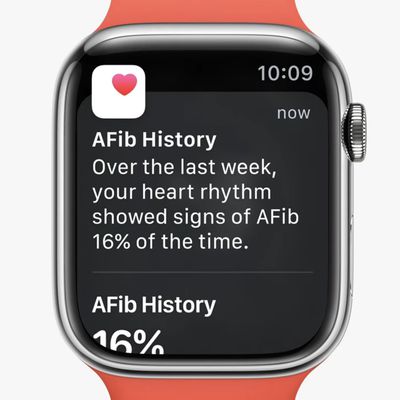
Apple today launched its atrial fibrillation history feature for Apple Watch in mainland China.
Since 2022, Apple Watch in the U.S. has supported AFib History, which allows users diagnosed with atrial fibrillation to view an estimate of how frequently their heart is in this type of irregular rhythm.
The feature analyzes pulse rate data collected by a photoplethysmography (PPG) sensor to...
Thursday March 19, 2026 3:10 pm PDT by Juli Clover
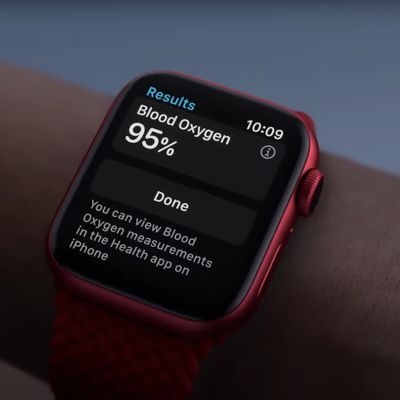
Apple's current blood oxygen sensing implementation in the U.S. does not infringe on patents owned by Masimo and Apple will not face a revived import ban, a U.S. International Trade Commission judge said this week (via Reuters).
After Apple was found to have violated Masimo's patents related to blood oxygen sensing, the Apple Watch faced a U.S. import ban that caused Apple to briefly pause...
I guess I still don't understand why the watch would be paired with headphones or store music when it must be paired with a phone that does both as well.
The example I can think of is when you're running or working out and don't want to bring your phone.
Just heard a friend of mine the other day mention something about how they didn't understand how blind or deaf or other impaired people can use computers. Here's a great example. Good to see these types of options being implemented.
I wonder if they can somehow implement the taptic engine with accessibility features. There's gotta be something there to help say people who are deaf.
A killer feature for blind folks (so it can be done discreetly), is if the taptic tapping could tap out the time. e.g. 2:53, two taps for 2, brief pause, 5 taps, brief pause, 3 taps. Something like that. They'd then be able to 'see' the time and others wouldn't hear it speaking.