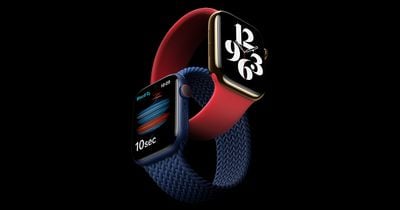
According to market data from Counterpoint Research, Apple shipped 12.9 million models of the Apple Watch Series 6 and Apple Watch SE in the fourth quarter of 2020.
The market saw an overall decline in smartwatch shipments compared to last year due to the ongoing global health crisis. Apple, however, saw a 19% increase in shipments YoY. Apple was the single largest smartwatch maker in Q4 of 2019 when it controlled 34% of the market. In the final quarter of last year, Apple Watch models accounted for 40% of the market share.
Apple's market share consolidation can be attributed to the new Apple Watch SE's success, the mid-range Apple Watch option. Apple released the SE model alongside its flagship Series 6 at a lower $279 price point, with some caveats such as the lack of an always-on display, ECG functionality, and the faster S6 processor.
Counterpoint senior analyst Sujeong Lim says that the new mid-range Apple Watch SE will likely push Samsung and other smartwatch makers to create similar, mid-range options for customers looking for cheaper alternatives to main flagships.
Sunday November 1, 2026 3:34 am PST by Tim Hardwick
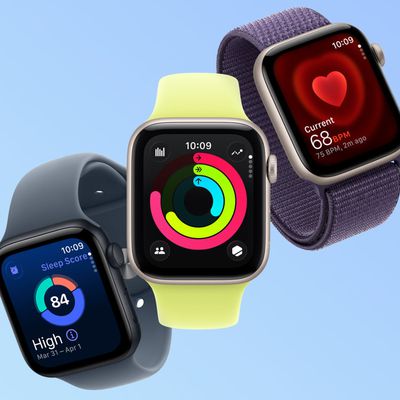
Apple has published a support document describing what to do if your Apple Watch continues to show time that's off by one hour after daylight savings time changes. "This incorrect time appears only on the Always On display when your wrist is down," says Apple. "When you activate the display by tapping it or raising your wrist, the time changes to the correct hour."
To fix the issue, Apple says ...
Apple increased its share of worldwide PC shipments in the third quarter of 2026, with Counterpoint Research crediting the MacBook Neo for some of the company's resilience during a market downturn.
The firm's preliminary estimates put Mac shipments at 5.6 million units, an 11% decrease from the same quarter last year. Worldwide PC shipments fell 21% to 57 million units, allowing Apple's...
China is doing much of the heavy lifting for Apple's iPhone 18 Pro launch, with a 29% sales increase helping offset declines in the U.S. and Japan, according to Counterpoint Research.
Combined global sales of the iPhone 18 Pro and iPhone 18 Pro Max rose 3.1% during their first three weeks of availability compared with the equivalent launch period last year. U.S. sales fell 4%, while Japan...
“Second largest” after “Others”??? How about an edit to correct this. “Others” is only a grab-bag of all the other unidentified manufacturers - Apple was the largest by a huge margin.
This is the forum thread ('https://forums.macrumors.com/threads/apple-announces-apple-watch-available-in-early-2015-from-349.1773623/') on the day the Apple Watch was first announced in September 2014.
Here's a couple of examples of the characteristic MacRumors' forum optimism about new Apple products:
One miniaturisation too far. A white elephant. Look for them in eBay in a year. Do you want to be "That Knob With The Apple Watch Over There?" And by 'Knob' we aren't referring to The Digital Crown here, readers.
While I have never been a watch person, I was surprised at how quickly I got used to using the AW. I now feel kind of naked when I am not wearing it.
One thing I hate about the AW, is the handling of SW updates and the small storage size. I cannot update the OS due to not having enough free space. I tried deleting everything that was optional to delete, and I still couldn't free up enough space to do the update.
It appears that if I unpair and reset the watch, I can do the update, but this is a pretty crappy way of handling SW updates.
Overall, I am happy with it, but the SW update issues are quite annoying.
Apple's sudden overtaking of the market can be attributed to the new Apple Watch SE's success, the mid-range Apple Watch option. Apple released the SE model alongside its flagship Series 6 at a lower $279 price point, with some caveats such as the lack of an always-on display, ECG functionality, and the faster S6 processor.
The rest of the tech industry could be in some serious trouble if apple keep releasing these mid range products with flagship processors.
Basically, they were able to sell some only once they cheapened the product with less features and quality. Anyone who uses Android can now use Fitbit which actually has more battery life and is an actual health device. I feel that Fitness+ should be brought to anti-trust by other fitness apps just like Spotify vs Apple.
This is precisely what I was talking about in the other thread.
In what bizarro world is a great user experience for the customer, made possible by Apple's tight integration between hardware, software and services, suddenly a sign of monopolistic behaviour by Apple?