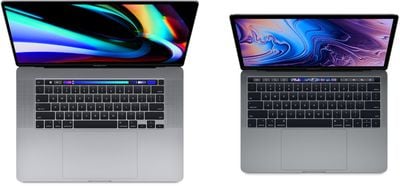
Following rumors of a performance-boosting "Pro Mode" coming in the next update to macOS Catalina, developer Marco Arment has argued that Apple should bring an iPhone-style Low Power Mode to MacBooks as well.
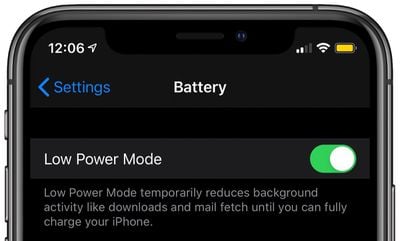
Since iOS 9, Apple has included a Low Power Mode on iPhones that reduces the amount of power that the device uses when the battery gets low, and Arment this week shared his experience with his own self-styled equivalent for macOS.
His method involves the use of a third-party app called Turbo Boost Switcher Pro that enables users to disable Intel Turbo Boost on a Mac's processor. According to Arment, disabling Turbo Boost has increased his 16-inch MacBook Pro's battery life by an estimated 30-50 percent and made it "a much better laptop" the vast majority of the time he uses it.
With Turbo Boost disabled, peak CPU power consumption drops by 62%, with a correspondingly huge reduction in temperature. This has two massive benefits:
The fans never audibly spin up. When Turbo Boost is enabled, the fans annoyingly spin up every time the system is under a heavy sustained load. Disable it, and it’s almost impossible to get them to be audible.
It runs significantly cooler. Turbo Boost lets laptops get too hot to comfortably hold in your lap, and so much heat radiates out that it can make hands sweaty. Disable it, and the laptop only gets moderately warm, not hot, and hands stay comfortably dry.
Arment claims that despite the reduction in processing power, his MacBook Pro is "still fast enough to do everything I need (including significant development with Xcode)." His only concern is that the app which allows him to enjoy these benefits is on borrowed time: Turbo Boost Switcher Pro relies on a legacy kernel extension that likely won't be supported in future versions of macOS.
"I suspect that this is the last year I'll get to run the latest OS and be able to turn off Turbo Boost at will, making all of my future laptop usage significantly worse," says Arment.
An iPhone's Low Power Mode reduces battery usage by disabling background app refreshing and automatic downloads, locking the screen after 30 seconds, and via other methods. Would you be happy to see an optional Low Power Mode in a future version of macOS, too? Let us know in the comments.
Bloomberg's Mark Gurman has high expectations for Apple's first foldable iPhone.
In his Power On newsletter today, he said the foldable iPhone will be "the most significant overhaul in the iPhone's history."
"iPhone 4, iPhone 6 and iPhone X were clearly a big deal, but this is a whole new design," he said.
Like Samsung's Galaxy Z Fold 7, the foldable iPhone will reportedly open up like ...
iOS 26.5 is now available for developers, and while it doesn't include any new Siri capabilities, there are some major changes for the European Union, and smaller tweaks for features available worldwide.
Suggested Places
In the Maps app, there's a new "Suggested Places" feature that recommends locations to visit based on trending places nearby and recent searches. When Apple launches ads in ...
Tuesday March 31, 2026 10:36 am PDT by Joe Rossignol
Apple today added the MacBook Air (13-inch, 2017) to its "vintage" products list, meaning the device is now only eligible for repairs at Apple Stores and Apple Authorized Service Providers if parts remain available.
The MacBook Air (13-inch, 2017) was the final MacBook Air model released before Apple redesigned the laptop and gave it a Retina display in 2018.
Apple also added all iPad...
Apple on Monday unveiled the iPhone 17e and an updated iPad Air, but it is not finished yet. Apple promised "a big week ahead," and it is expected to announce additional new products this Tuesday, March 3 and Wednesday, March 4.
The most likely possibilities for Tuesday include updated 13-inch and 15-inch MacBook Air models with the M5 chip, and higher-end 14-inch and 16-inch MacBook Pro...
Apple today announced new 14-inch and 16-inch MacBook Pro models featuring M5 Pro and M5 Max chips, both built on a new Fusion Architecture that bonds two third-generation 3nm dies into a single chip using advanced packaging.
The Fusion Architecture is a first for Apple silicon, since previous chips used a single-die design. The two bonded dies house the CPU, GPU, Media Engine, Neural...
With the debut of the M5 Pro and M5 Max MacBook Pro models, Apple tweaked the available configurations for the standard M5 MacBook Pro.
The 14-inch M5 MacBook Pro used to start with 512GB of storage, but Apple has removed that option. All MacBook Pro models, including the entry-level M5 version, start with a 1TB SSD that can be upgraded to 4TB.
The starting price of the M5 MacBook Pro was ...
The reason I’ve been a Mac user rather than a Windows user for the past 20 years was because a Mac historically “just worked.” They were computers to do work on.
I want my computer to intelligently adapt itself to what I’m doing. I want it to manage its own updates. I just don’t want it to bother me and I don’t want to have to spend any time configuring or maintaining it.
You won't have to change this, but others may want to
The reason I’ve been a Mac user rather than a Windows user for the past 20 years was because a Mac historically “just worked.” They were computers to do work on.
I want my computer to intelligently adapt itself to what I’m doing. I want it to manage its own updates. I just don’t want it to bother me and I don’t want to have to spend any time configuring or maintaining it.
It wouldn't need a low power mode if the MBP able to offer an all-week battery life.
Battery life isn't the only benefit, mainly heat and fan noise, which can really improve the experience of using the machine.
Most workflows don't even need a powerful processor so there is usually a lot of potential energy, heat and noise that can be avoided without the user noticing any difference in performance.
Low power mode would be an excellent option on the Mac. I use it - not often, but occasionally - on my iPhone, and those times it's very useful to stretch the power whenever I'm away from any power outlets... :)