Apple Could Adopt Hybrid OLED Technology for Future iPads
Apple's rumored plans to transition to OLED technology for future iPad models could involve using "hybrid" OLED technology that combines both rigid and flexible OLED panel materials, according to The Elec (original Korean-language version).
The report claims that Apple is reluctant to rely solely on the flexible OLED technology it uses in its iPhone models, as the panels have a tendency to "crumple" and the effect is more noticeable as displays get larger.
From a machine translation of the original Korean-language report:
When it became known that Apple plans to apply hybrid OLED to the first OLED iPad, the industry has assumed that the cause was cost reduction.
However, it is understood that there is a reason why Apple preferred hybrid OLED other than this cost reduction. An official from the parts industry said, "Apple hated the fact that a part of the product screen could look wrinkled to the user's eyes when using a flexible OLED." He said, "iPhone OLED has a 5-7 inch screen, so these characteristics are not well revealed, but it is relatively noticeable in large-screen (10-20 inch) IT products. he explained.
While the hybrid OLED technology has yet to be perfected and will take at least a year to become commercially viable before it could be incorporated into an OLED iPad by around 2024, the report says both Samsung and LG are pursuing ultra-thin glass substrates measuring just 0.2 mm thick to be used with the technology, down from the current standard of around 0.5 mm.
The report does say that Apple may still elect to use flexible OLED panels in iPad models if the shortcomings can be addressed, but at least for now, it appears hybrid panels may be a better option as they are thinner than rigid panels and cheaper than flexible panels.
Popular Stories
Bloomberg's Mark Gurman has high expectations for Apple's first foldable iPhone.
In his Power On newsletter today, he said the foldable iPhone will be "the most significant overhaul in the iPhone's history."
"iPhone 4, iPhone 6 and iPhone X were clearly a big deal, but this is a whole new design," he said.
Like Samsung's Galaxy Z Fold 7, the foldable iPhone will reportedly open up like ...
iOS 26.5 is now available for developers, and while it doesn't include any new Siri capabilities, there are some major changes for the European Union, and smaller tweaks for features available worldwide.
Suggested Places
In the Maps app, there's a new "Suggested Places" feature that recommends locations to visit based on trending places nearby and recent searches. When Apple launches ads in ...
Apple today added the MacBook Air (13-inch, 2017) to its "vintage" products list, meaning the device is now only eligible for repairs at Apple Stores and Apple Authorized Service Providers if parts remain available.
The MacBook Air (13-inch, 2017) was the final MacBook Air model released before Apple redesigned the laptop and gave it a Retina display in 2018.
Apple also added all iPad...
Popular Stories
Apple is planning to launch at least three new "Ultra"-class devices this year, according to Bloomberg's Mark Gurman.
Writing in this weekend's "Power On" newsletter, Gurman explained that while the low-end of Apple's product lineups are now well-served by the Apple Watch SE, iPad 11, and MacBook Neo, there is "a more significant shift underway" toward higher-end, "Ultra" devices. Apple is...
Apple is planning to launch an all-new "MacBook Ultra" model this year, featuring an OLED display, touchscreen, and a higher price point, Bloomberg's Mark Gurman reports.
Gurman revealed the information in his latest "Power On" newsletter. While Apple has been widely expected to launch new M6-series MacBook Pro models with OLED displays, touchscreen functionality, and a new, thinner design...
Apple is planning to launch a MacBook Air with an OLED display, but it won't come for several years after the MacBook Pro is updated with OLED screen technology.
We're not going to see an OLED MacBook Air until at least 2028, according to Bloomberg. Large, high-quality OLED displays are expensive, and it will take some time for the technology to come down in price enough that it can be used...


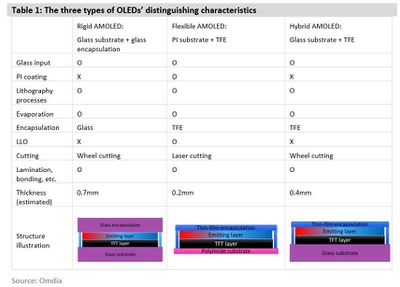 OLED technology comparison table via Omdia