Intel today previewed the next generation of Thunderbolt, which would enable ultra-fast data transfer speeds and improved external display support on future Macs that incorporate the standard when it launches in 2023 or later.
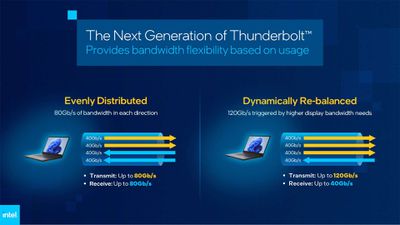
The next generation of Thunderbolt will deliver up to 80 Gbps of bandwidth in each direction, allowing for up to 2× faster data transfer speeds between future Macs and external storage drives that support the standard compared to current speeds. The next generation of Thunderbolt will also have a mode that allows for up to 120 Gbps bandwidth for external displays, which would allow a Mac to support up to dual 8K displays at 60Hz.
The latest 14-inch and 16-inch MacBook Pro models are equipped with Thunderbolt 4/USB4 ports with up to 40 Gbps of bandwidth in each direction.
Currently, no Macs support 8K displays on a plug-and-play basis. The latest 14-inch and 16-inch MacBook Pro models support up to two or three external displays at up to 6K@60Hz depending on whether the laptop is configured with the M1 Pro or M1 Max chip.
The next generation of Thunderbolt is based on the newly released USB4 version 2.0 and DisplayPort 2.1 specifications, and it is backwards compatible with previous versions of Thunderbolt, USB, and DisplayPort. Intel plans to share more details about the next generation of Thunderbolt's official name, features, and capabilities in 2023.
Bloomberg's Mark Gurman has high expectations for Apple's first foldable iPhone.
In his Power On newsletter today, he said the foldable iPhone will be "the most significant overhaul in the iPhone's history."
"iPhone 4, iPhone 6 and iPhone X were clearly a big deal, but this is a whole new design," he said.
Like Samsung's Galaxy Z Fold 7, the foldable iPhone will reportedly open up like ...
iOS 26.5 is now available for developers, and while it doesn't include any new Siri capabilities, there are some major changes for the European Union, and smaller tweaks for features available worldwide.
Suggested Places
In the Maps app, there's a new "Suggested Places" feature that recommends locations to visit based on trending places nearby and recent searches. When Apple launches ads in ...
Tuesday March 31, 2026 10:36 am PDT by Joe Rossignol
Apple today added the MacBook Air (13-inch, 2017) to its "vintage" products list, meaning the device is now only eligible for repairs at Apple Stores and Apple Authorized Service Providers if parts remain available.
The MacBook Air (13-inch, 2017) was the final MacBook Air model released before Apple redesigned the laptop and gave it a Retina display in 2018.
Apple also added all iPad...
Wednesday March 4, 2026 6:17 am PST by Juli Clover
Apple is now accepting pre-orders for all of the new products that it announced this week. Everything can be ordered from the online Apple Store following the debut of the new low-cost MacBook earlier this morning, with deliveries starting on Wednesday, March 11.
Here's a list of what you can order now, with pricing details included.
MacBook Neo - The 13-inch MacBook Neo has an A18 Pro...
Wednesday March 4, 2026 4:55 pm PST by Joe Rossignol
None of the new MacBook Neo, MacBook Air, or MacBook Pro models unveiled this week come with a charger in the UK and EU countries, such as Germany, France, Italy, and Spain. This change began with the base 14-inch MacBook Pro last year.
If you need a power adapter, you must purchase one separately during checkout or later.
In all other countries, Apple includes a charger in the box with...
The first Geekbench 6 result for a 16-inch MacBook Pro with the M5 Max chip surfaced today, and Apple has achieved record-breaking performance.
In this unconfirmed result, the M5 Max with an 18-core CPU achieved a score of 29,233 for multi-core CPU performance, which tops the 27,726 score achieved by the Mac Studio's M3 Ultra chip with a 32-core CPU. M5 Max is now the fastest Apple silicon...
If im in the Apple Store and I move the pointer on a Mac Studio with Pro Display XDR and compare it to moving the pointer on a M1 MacBook Pro, the XDR feels like the pointer is underwater- slow and sluggish. Same for all 4k screens I try and exacerbated if MacOS is performing scaling. Now we're cueing up 8k.
Wonder if that will ever be worked out? "Supporting" a screen is one thing, but I still have to pass if it feels sluggish. Is it just me?
An M1 MacBook Pro has a 120Hz display, while the Pro Display XDR is 60Hz. Could that make the difference?