The M2 Pro and M2 Max MacBook Pro models feature a considerably smaller heatsink due to supply chain issues, teardowns suggest.
Top: M1 Pro logic board with larger heatsink. Bottom: M2 Pro logic board with smaller heatsink (via iFixit).
The new MacBook Pro's revised thermal architecture appears to be caused by the reduced overall footprint of the M2 Pro and M2 Max SoCs inside the device, as noted by iFixit and Max Tech. The M1 Pro and M1 Max MacBook Pro models contained two, large memory modules, but the M2 Pro and M2 Max MacBook Pro models contain four slimmer memory modules. Even though the M2 Pro and M2 Max dies are physically larger than those of the M1 Pro and M1 Max, the SoCs as a whole take up less space.
Left: M1 Pro SoC. Right: M2 Pro SoC (via iFixit).
This means that the M2 Pro and M2 Max MacBook Pro models do not require a heatsink as large as the one used for the previous generation. It is not clear if this significantly impacts thermal efficiency.
The reason for the use of four smaller memory modules appears to be supply chain issues. The entire SoC is mounted on a substrate, so four smaller modules allow Apple to use a smaller substrate, making a saving on materials and reducing complexity as a result. Dylan Patel, Chief Analyst at SemiAnalysis, told iFixit:
ABF substrates were in very short supply when Apple made the design choice. By using four smaller modules rather than two larger ones, they can decrease routing complexity within the substrate from the memory to the SoC, leading to fewer layers on the substrate. This allows them to stretch the limited substrate supply further.
The M2 Pro and M2 Max deliver up to 20 percent better CPU performance and 30 percent better GPU performance than their predecessors, but since the chips continue to be based on TSMC's 5nm process, some users have noted that Apple may have made thermal tradeoffs in order to deliver improved performance.
Bloomberg's Mark Gurman has high expectations for Apple's first foldable iPhone.
In his Power On newsletter today, he said the foldable iPhone will be "the most significant overhaul in the iPhone's history."
"iPhone 4, iPhone 6 and iPhone X were clearly a big deal, but this is a whole new design," he said.
Like Samsung's Galaxy Z Fold 7, the foldable iPhone will reportedly open up like ...
iOS 26.5 is now available for developers, and while it doesn't include any new Siri capabilities, there are some major changes for the European Union, and smaller tweaks for features available worldwide.
Suggested Places
In the Maps app, there's a new "Suggested Places" feature that recommends locations to visit based on trending places nearby and recent searches. When Apple launches ads in ...
Apple has been celebrating its upcoming 50th anniversary by hosting surprise performances and other events around the world over the past few weeks, and now Bloomberg's Mark Gurman has revealed details about the company's grand finale.
In a social media post, Gurman said Apple's celebrations will conclude this week with a finale at its Apple Park headquarters for employees.
A special...
Apple on Monday unveiled the iPhone 17e and an updated iPad Air, but it is not finished yet. Apple promised "a big week ahead," and it is expected to announce additional new products this Tuesday, March 3 and Wednesday, March 4.
The most likely possibilities for Tuesday include updated 13-inch and 15-inch MacBook Air models with the M5 chip, and higher-end 14-inch and 16-inch MacBook Pro...
Apple today announced new 14-inch and 16-inch MacBook Pro models featuring M5 Pro and M5 Max chips, both built on a new Fusion Architecture that bonds two third-generation 3nm dies into a single chip using advanced packaging.
The Fusion Architecture is a first for Apple silicon, since previous chips used a single-die design. The two bonded dies house the CPU, GPU, Media Engine, Neural...
With the debut of the M5 Pro and M5 Max MacBook Pro models, Apple tweaked the available configurations for the standard M5 MacBook Pro.
The 14-inch M5 MacBook Pro used to start with 512GB of storage, but Apple has removed that option. All MacBook Pro models, including the entry-level M5 version, start with a 1TB SSD that can be upgraded to 4TB.
The starting price of the M5 MacBook Pro was ...
That's not a heatsink. That's just the interface block that you are describing. The heat is transferred to the two radiator fins. The fans then blow air across the fins. The radiator fins are the heat sink. At least, that's what I classically think of as the heatsink.
This interface block completely covers the chip. It's fine.


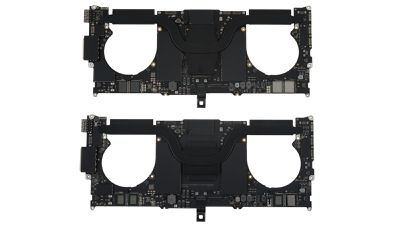 Top: M1 Pro logic board with larger heatsink. Bottom: M2 Pro logic board with smaller heatsink (via iFixit).
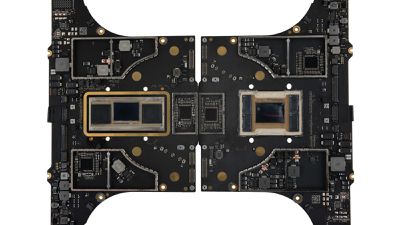 Left: M1 Pro SoC. Right: M2 Pro SoC (via iFixit).