Early Benchmarks on the New 13-Inch and 11-Inch MacBook Air
Primate Labs
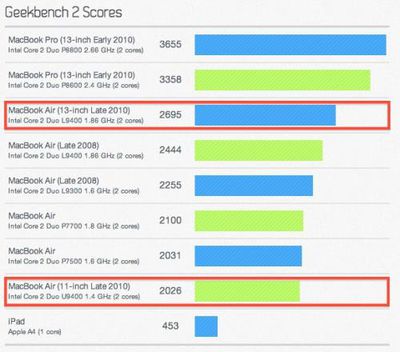
publishes initial benchmarks for Apple's new 13-inch and 11-inch MacBook Air, comparing the new models to earlier generations of the MacBook Air, the current 13-inch MacBook Pro, and the iPad.
There are two ways you can look at the new 11-inch MacBook Air; it's either a much smaller but slower MacBook Pro, or a much faster but larger iPad. The 11-inch MacBook Air is small enough that I'd consider bringing it instead of an iPad, but I'd worry it's not fast enough (or have enough screen space) to be my primary laptop.
The 13-inch MacBook Air is a much more straightforward produc; it has 80% of the processor performance of the latest 13-inch Pro, making it an acceptable substitute for users looking for a slightly more portable Pro.
The report emphasizes, however, that Geekbench only measures processor and memory performance, leaving out what is expected to be significant overall performance improvements over earlier generations due to the use of the NVIDIA GeForce 320M video card and flash storage across all models.
Popular Stories
Apple today updated its U.S. trade-in estimates, raising maximum values across the iPad lineup and for most Macs following today's announcement of the new iPad mini.
Every iPad category has gained value, although the increases are relatively modest. The iPad mini and standard iPad both rise by $20, while the iPad Air gains $15 and the iPad Pro increases by $10. The revised maximum estimates...
Apple is testing OLED displays for future MacBook Air and iMac models, though both upgrades remain some way off, according to Bloomberg's Mark Gurman in his latest "Power On" newsletter.
The next refreshes of the devices are expected to retain LCD displays. Gurman anticipates a new iMac to arrive this week and a MacBook Air refresh in early 2027, but offered no time frame for either model's...
Apple has made a change to its development process for iOS 28, macOS 28, and corresponding software updates, according to Bloomberg's Mark Gurman.
In his Power On newsletter today, he said Apple separates development of each year's new operating systems into three major stages. Typically, he said each stage consists of four weeks of coding followed by a four-week "convergence" period where...