Thunderbolt Cable Teardown Reveals Electronics and Firmware - MacRumorsOpen MenuShow RoundupsShow Forums menuVisit ForumsOpen Sidebar
Skip to Content

Thunderbolt Cable Teardown Reveals Electronics and Firmware

As noted by Arstechnica and iFixIt, Apple's new $50 Thunderbolt cable is actually a "smart" or "active" cable that contains circuitry and firmware. Arstechnica explains:

A source within the telecom industry explained to Ars that active cables are commonly used at data rates above 5Gbps. These cables contain tiny chips at either end that are calibrated to the attenuation and dispersion properties of the wire between them. Compensating for these properties "greatly improves the signal-to-noise ratio" for high-bandwidth data transmission.

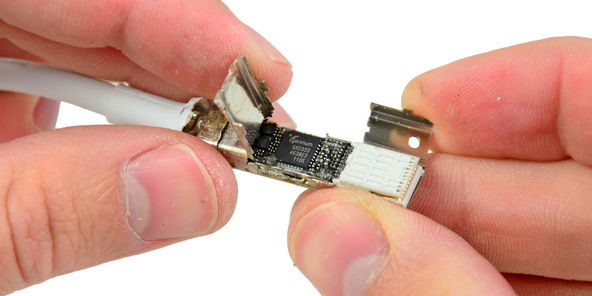
iFixIt tore down the new ThunderBolt cable and found two Gennum GN2033 chips in the connector, one on each side. Additional support chips and resistors were also found for total of 12 chips and "tons" of smaller electronic components.
QBZvGuXR2nRD64NM
Gennum's chip is described as a transceiver that enables "reliable data transfer at cutting-edge speeds over low cost, thin-gauge copper cables." Early benchmarks of Thunderbolt drive enclosures show massive improvements over FireWire 800.

One interesting benefit of this "active" cabling is that current Thunderbolt ports found in the iMac and MacBook Pro will be future-compatible with planned optical Thunderbolt cables. Optical cables were part of the original plans for Thunderbolt which promises to offer much higher speeds, but the first version released are based on traditional copper wiring. Intel still plans on upgrading to optical cabling in the future, and existing Thunderbolt devices should be compatible with new cabling. This was mentioned during the original Thunderbolt roll out.

...the port you'll find in new MacBook Pros and storage devices can actually take an optical cable when those are cost-effective enough to roll out, because Intel will eventually bake the optical transceivers into the cables themselves.

Ars, however, suggests that the high cost and complexity of the cabling may be a hurdle to widespread adoption of Thunderbolt.

Popular Stories

macOS 27 on MacBook Pro

Apple Says macOS 27 Won't Be Compatible With These Macs

Wednesday June 3, 2026 8:29 am PDT by
During WWDC 2025, Apple revealed that macOS 26 Tahoe would be the final major macOS version for Intel-based Macs. macOS 27 will be compatible with Apple silicon Macs only, meaning that you will need a Mac with an M-series chip or a MacBook Neo with an A18 Pro chip in order to install the software update. Apple will unveil macOS 27 during its WWDC 2026 keynote this Monday, June 8, and the...
MacBook Neo on Yellow Feature

MacBook Neo is So Popular That Apple Reportedly Doubled Production

Wednesday June 3, 2026 9:24 am PDT by
On an earnings call in late April, Apple's CEO Tim Cook said that customer response to the MacBook Neo was "off the charts," and the popularity of the laptop has reportedly led the company to significantly boost production. Apple supply chain analyst Ming-Chi Kuo this week said he believes that MacBook Neo shipments to Apple were doubled from an initial target of 5 million units to 10...
iphone 18 pro blue%402x

iPhone 18 Pro: Dark Cherry, Light Blue, and Dark Gray Chassis Leaked [Update]

Thursday June 4, 2026 5:18 am PDT by
Update: Since publication, new information has come to light suggesting the images have been AI-manipulated and are not in fact iPhone 18 Pro chassis parts. The original article follows. The color options Apple is reportedly planning for the upcoming iPhone 18 Pro and ‌iPhone 18 Pro‌ Max have appeared online today in the form of images of chassis parts of unknown authenticity....

Top Rated Comments

cmaier Avatar
195 months ago
Yeah, I don't think Monoprice is going to sell these things for $8 like everyone expected.
Score: 47 Votes (Like | Disagree)
RoelJuun Avatar
195 months ago
And still everybody keeps telling that Apple isn't interested in de Pro market and thinks only of the consumers ;)
Score: 18 Votes (Like | Disagree)
195 months ago
Not entirely surprising.

Keep in mind, Thunderbolt is two 10Gbps channels. Let's face it -- 20Gbps aggregate bandwidth is a LOT of bandwidth for an external cable which is getting up there in numbers to rival the amount of memory bandwidth most commodity computer chipsets have (I think two-channel X68 is 21.6Gbps), and those chipsets aren't exactly dirt cheap. This is bandwidth normally the realm of single mode fiber optics for cabling, and even then, the equipment on either side of that single mode cable isn't cheap.

This is not a dumb piece of shielded wire. This is a PCI-E breakout.

This is why the first thunderbolt peripherals are DAS RAID arrays and FCAL HBAs. This is stuff really intended for the professional market at the moment, not consumer devices, as there isn't a consumer device need for this crazy (yes, it's crazy!) amount of bandwidth. Not until production significantly catches up will things start to become cheap enough to make consumer devices.

This is why Apple is pushing Thunderbolt. Even in it's first incarnation it is an insane amount of overkill. It will not be quickly obsolesced.
Score: 17 Votes (Like | Disagree)
Justinf79 Avatar
195 months ago
And that's why they're $50. :)
Score: 14 Votes (Like | Disagree)
Eduardo1971 Avatar
195 months ago
Wow; is this the first time that iFix it has torn down a cable?

Too funny.:)
Score: 14 Votes (Like | Disagree)
elithrar Avatar
195 months ago
Why couldn't apple just put those chips in the computer themselves.
My gut feeling was so they have an excuse to charge an arm and a leg for the cables.

Because the chips help with handling attenuation on the cable, and it's part of the Thunderbolt spec. Without the chips, reaching 20Gbps over copper is incredibly hard.

PS: Read http://news.ycombinator.com/item?id=2711918 for a better understanding.
Score: 9 Votes (Like | Disagree)