EPEAT Verifies Retina MacBook Pro Eligibility for Environmental Registry - MacRumorsOpen MenuShow RoundupsShow Forums menuVisit ForumsOpen Sidebar
Skip to Content

EPEAT Verifies Retina MacBook Pro Eligibility for Environmental Registry

Four months ago, Apple pulled its products from the Electronic Product Environmental Assessment Tool (EPEAT) registry, with sources indicating that Apple's design direction for its increasingly thin mobile products was incompatible with EPEAT's criteria for "disassemble-ability" and other factors. Just a week later, Apple responded to significant criticism of the move by placing "all eligible products" back on the registry and issuing a letter from senior vice president Bob Mansfield acknowledging that their removal was a "mistake" for the company.

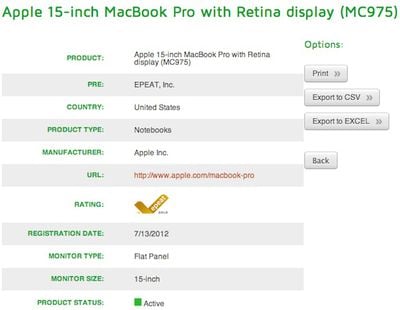
With Apple's products back on the registry, some observers were surprised to note that Apple's new Retina MacBook Pro was included, given that it had been the subject of criticism for recyclability issues, with the strong glue used to affix the battery to the casing being of particular concern. It was quickly noted that manufacturers grade themselves against the EPEAT criteria, and thus some believed that EPEAT's review of the grading would ultimately result in the Retina MacBook Pro losing its status on the registry.
epeat retina macbook pro
Last Friday, EPEAT issued a press release stating that it had performed verification studies on "ultrathin" laptops from four manufacturers, including Apple, and found that all of the tested models did indeed meet registry eligibility requirements. At the time, it was unclear which Apple models were included in the study, and we assumed that the ultrathin designation only addressed the MacBook Air, which has been deemed eligible for the past several generations.

Consequently, fresh verification of the MacBook Air was not necessarily a surprise, although EPEAT did find it necessary to both clarify the definition of "commonly available" tools for disassembly or upgrades and note that an expansion port such as Thunderbolt or USB is sufficient to contribute toward meeting the criteria of upgradeability.

iFixit's Kyle Wiens has, however, now confirmed to MacRumors that the EPEAT verification testing did indeed include the 15-inch Retina MacBook Pro, which the group is classifying as an ultrathin notebook despite the fact that it is substantially thicker and more powerful than the MacBook Air. In an opinion piece published at Wired today, Wiens addresses the impact of the decision, calling the new clarification of the EPEAT standards "greenwashing":

Apple’s Retina MacBook Pro – the least repairable, least recyclable computer I have encountered in more than a decade of disassembling electronics – was just verified Gold, along with four other ultrabooks. This decision demonstrates that the EPEAT standard has been watered down to an alarming degree. [...]

At best, the interpretation of the EPEAT Gold standard is laughably out of touch. At worst, it means recyclers a decade from now may be faced with a mountain of electronic waste they cannot affordably recycle without custom disassembly fixtures and secret manufacturer information.

Wiens goes on to provide an overview of how development of EPEAT's standards is weighted toward computer industry companies and how this has watered down the environmental criteria for the products.

Unfortunately, getting highly specific language into a standard like EPEAT is challenging because manufacturers claim it limits future innovation. So when language does finally make it into the standard, it’s critical to rigorously enforce it.

Where language is ambiguous, decisions must consider the goals of the standard, or risk negating its purpose entirely. The updated definitions systematically weaken the 1680.1 standard.

Apple's design direction is clearly weighted toward building products that are as slim and light as possible, using custom and proprietary components to achieve its goals at the cost of upgradeability and repairability. For most consumers who never see fit to upgrade their computers, the tradeoff is an acceptable, or even desirable, one. But for those who seek to keep their computers running as long as possible before purchasing a new machine, and even for any users interested in end-of-life recyclability of their products, Apple's tactics are undoubtedly cause for concern.

Related Roundup: MacBook Pro

Popular Stories

macOS 27 on MacBook Pro

Apple Says macOS 27 Won't Be Compatible With These Macs

Wednesday June 3, 2026 8:29 am PDT by
During WWDC 2025, Apple revealed that macOS 26 Tahoe would be the final major macOS version for Intel-based Macs. macOS 27 will be compatible with Apple silicon Macs only, meaning that you will need a Mac with an M-series chip or a MacBook Neo with an A18 Pro chip in order to install the software update. Apple will unveil macOS 27 during its WWDC 2026 keynote this Monday, June 8, and the...
MacBook Neo on Yellow Feature

MacBook Neo is So Popular That Apple Reportedly Doubled Production

Wednesday June 3, 2026 9:24 am PDT by
On an earnings call in late April, Apple's CEO Tim Cook said that customer response to the MacBook Neo was "off the charts," and the popularity of the laptop has reportedly led the company to significantly boost production. Apple supply chain analyst Ming-Chi Kuo this week said he believes that MacBook Neo shipments to Apple were doubled from an initial target of 5 million units to 10...
iphone 18 pro blue%402x

iPhone 18 Pro: Dark Cherry, Light Blue, and Dark Gray Chassis Leaked [Update]

Thursday June 4, 2026 5:18 am PDT by
Update: Since publication, new information has come to light suggesting the images have been AI-manipulated and are not in fact iPhone 18 Pro chassis parts. The original article follows. The color options Apple is reportedly planning for the upcoming iPhone 18 Pro and ‌iPhone 18 Pro‌ Max have appeared online today in the form of images of chassis parts of unknown authenticity....

Top Rated Comments

Glassed Silver Avatar
178 months ago
This is great news! Likely it will increase Apple's sales and most importantly for all of us, its profits.

Apple is the greenest company in the world, and it is great that they are getting the recognition that they so richly deserve. I hope that their stock skyrockets due to this news.

The kool-aid is strong in this one...

Glassed Silver:mac
Score: 14 Votes (Like | Disagree)
aristotle Avatar
178 months ago
iFixit is obviously biased as they want to be able to sell parts and services to people.

True greenwashing is when a product is supposedly repairable and recyclable but becomes quickly obsolete and is either discarded within a couple of years due to obsolescence or breaking down. The cheap laptops contribute far more to e-waste that a typical Apple product due to its longevity and durability.

@JayLenochiniMac:Where do you think all of those cheap disposable electronics end up? They end up in another country shipped by a so-called "recycler" where children play. Even the most recyclable electronics have some parts that end up as e-waste in another country putting the health of people living there at risk.
Score: 10 Votes (Like | Disagree)
mdelvecchio Avatar
178 months ago
the ifixit guys is really saying: "Eek! I can't sell parts and repair guide hits to this product! I'm going to go the way of the TV repair shop!"

seriously. who laments the inability to perform user repairs on flat-panel TVs, receivers, car stereos, etc... nobody. nobody does. you send it in to the manufacturer or you get another one. EOS. this despite the fact that my grandfather used to be able to repair his own television.

why would we expect notebooks to be ANY different?

as for recycling, AFAIA, Apple is happy to take it off your hands for recycling. whats the problem there?
Score: 5 Votes (Like | Disagree)
jmgregory1 Avatar
178 months ago
Recyclability (of electronics and other things) will forever be a moving target as technology changes. Just trying to make comparisons to the recyclability of a retina macbook pro today makes almost no sense given it will have almost zero pieces hitting the recycling network for what, the next 3 years at the earliest?

This is mostly true for all Apple products - because they don't build throw-away, cheap, products (for the most part). Maybe some institutions and the government will toss a 3 year old Retina MacBook Pro away (to be recycled) because they're wasteful spenders, but I suspect that like most people who own Apple products, you end up keeping them and using them, passing the old down to someone else, or selling them to someone who will continue to use them.

That $400 Dell/HP/Lenovo/Asus laptop is the more likely product to hit the recycling system in big numbers given they're made cheap with the expectation that they'll be replaced in a couple of years - recycled or tossed because they're not worth keeping after that.

And if recyclers are simply doing nothing to change how they recycle over the next 3+ years, then aren't they part of the problem?
Score: 4 Votes (Like | Disagree)
blackhand1001 Avatar
178 months ago
Disclaimer: I'm not trying to defend Apple so much as explain how the technology world works imo. EPEAT didn't even exist when laptops first came out.

"Standard" laptop parts today were not standard or easily recyclable when they were first released. In fact, they were proprietary and innovative. Other companies reversed engineered and made it better. For the past decade, the "same" design was somewhat adopted by most major manufacturers. Recycling these laptops grew easier over time.

Apple comes along and does a major change to how laptops are built. Other companies will follow. Recycling will be easier over time. It's a loop that'll likely be repeated again and again. We do have to deal with a few years of adjusting.

No, when you start gluing electronics its not easier to disassemble.
Score: 4 Votes (Like | Disagree)
aerok Avatar
178 months ago
Apple is the greenest company in the world, and it is great that they are getting the recognition that they so richly deserve. I hope that their stock skyrockets due to this news.

Hmm... I pretty sure Trader Joe's is a hell lot greener than Apple...
Score: 4 Votes (Like | Disagree)