Android Slips as Apple Gains Enterprise Market Share in Q3 2014 - MacRumorsOpen MenuShow RoundupsShow Forums menuVisit ForumsOpen Sidebar
Skip to Content

Android Slips as Apple Gains Enterprise Market Share in Q3 2014

by

Reversing a trend of quarterly declines, Apple's iOS mobile operating system gained market share this past quarter as it continued to dominate in the enterprise market. Apple's expansion came at Android's expense, which lost ground, according to Good Technology's latest Mobility Index Report (via VentureBeat).
ios-enterprise-activations
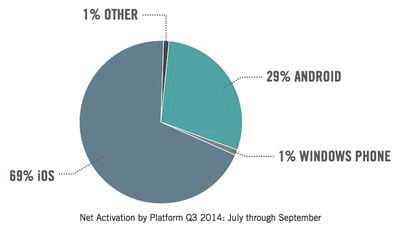
In Q3 2014, iOS device activations in the enterprise sector grew two percentage points, expanding from 67 to 69 percent. Android, concomitantly, slipped 2 percent, accounting for 29 percent of net device activations. Windows Phone remained a very distant third with only 1 percent of activations, a figure that has remained flat for the past six quarters.
ios-tablets-enterprise
Much of Apple's quarterly gain can be attributed to the launch of the iPhone 6 and iPhone 6 Plus, which caused a surge in iOS device activations in September.

Good Technology says “The release of the iPhone 6 and iPhone 6 Plus accounted for all of this gain.” More specifically, iOS was down to 66 percent of activations in July and August, but comprised 73 percent of September activations thanks to sales of the new devices.

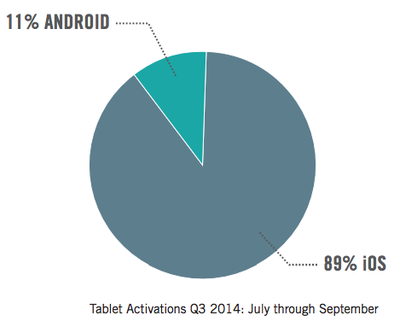
In the tablet enterprise market, Apple also remained the dominant tablet manufacturer with its iPad models, but faced an increasing challenge from Android tablets. In the just-ended quarter, Android increased its market share, climbing slightly to grab 11 percent of tablet device activations as compared to the iPad's 89 percent share.

Apple increasingly has been focused on the mobile enterprise market, updating its enterprise-level mobile device management tools earlier this year and recently partnering with IBM to develop new business apps and services for Apple's iOS devices. As part of the Apple-IBM collaboration, IBM will provide iOS-optimized cloud services, develop industry-specific apps, and begin selling iOS devices to its corporate clients.

Related Roundup: iPad
Buyer's Guide: iPad (Don't Buy)
Related Forums: iPad, iPhone

Top Rated Comments

keysofanxiety Avatar
152 months ago
Blackberry doesn't even show up as its own slice anymore. Oh, how the tables have turned.

I know. It's a scary picture when you consider how synonymous BlackBerry were with business. It just goes to show that if you're complacent, you will fall - no matter who you are.
Score: 6 Votes (Like | Disagree)
MacTCE Avatar
152 months ago
i also found that surprising after all everyone knows that just last year android had a commanding 80+% lead. so i decided to google it. and this is what i found (from a un-biased site)

You're not comparing apple's to apple's. The graph you posted is market share and the one posted MR is on activations.
Score: 4 Votes (Like | Disagree)
152 months ago
Blackberry doesn't even show up as its own slice anymore. Oh, how the tables have turned.

I was surprised by that also. However, I found this in the original Good Technology report:

"Due to the fact that RIM devices use only the BlackBerry® Enterprise Server for corporate email access, Good does not have insight into BlackBerry handset activation trends; and they are not reflected in this report."
Score: 3 Votes (Like | Disagree)
kdarling Avatar
152 months ago
Why would it be meaningless to know which devices US corporations are buying? No one said it predicted anything in the full market. Just because it doesn't do that doesn't mean it isn't useful information. What if you develop business centric mobile apps?
This is not necessarily about what corporations are buying. This is about registering a device to access corporate info, a device which is often someone's personal phone.

In this case, the bump is more about people registering their new iPhone in place of their previous iPhone.

Happens every year in the Good report, when a new iPhone model comes out:

Much of Apple's quarterly gain can be attributed to the launch of the iPhone 6 and iPhone 6 Plus, which caused a surge in iOS device activations in September.
Score: 2 Votes (Like | Disagree)
152 months ago
Just the US, just the corporate-paid, so the whole pie itself is nothing in the full market. Meaningless report, in another word.
Why would it be meaningless to know which devices US corporations are buying? No one said it predicted anything in the full market. Just because it doesn't do that doesn't mean it isn't useful information. What if you develop business centric mobile apps?
Score: 2 Votes (Like | Disagree)
KieranDotW Avatar
152 months ago
Blackberry doesn't even show up as its own slice anymore. Oh, how the tables have turned.
Score: 2 Votes (Like | Disagree)

Popular Stories

iOS 26 Glass Photos Feature

Apple Brings Full-Resolution iCloud Shared Albums to Android and Windows

Monday June 8, 2026 3:57 pm PDT by
Apple today announced an update to iCloud Shared Albums to allow friends and family on Android and Windows to join and contribute photos more conveniently, with support for full-resolution images. The improvement for Android and Windows users removes a notable friction point for mixed-device groups, enabling users outside the Apple ecosystem to participate in shared albums via iCloud.com...
RCS Feature 1

iOS 27 Beta 2 Adds Inline Replies to iPhone-to-Android RCS Chats

Monday June 22, 2026 12:06 pm PDT by
With the second beta of iOS 27, Apple added support for replying to a specific message in an RCS conversation with an Android user. You can now long press on a message to get to the option to reply, and it works the same way that it does with iMessage. iOS 27 also displays tapback/reaction emoji to images and videos properly. In iOS 26, it would use a text descriptor, such as [x loved...
apple price hike

Apple Just Increased Prices on MacBooks, iPads, and More

Thursday June 25, 2026 5:44 am PDT by
Apple today dramatically increased device prices across multiple product lines. Subscribe to the MacRumors YouTube channel for more videos. After temporarily taking it down earlier today, Apple's online store is back up with a series of product price increases. The changes are as follows: HomePod mini: $129, up from $99 (+$30) HomePod: $349, up from $299 (+$50) Apple TV: $199, up from...