
New Semiconductor Processes Offer Power Efficiency Opportunities for Apple Watch - MacRumorsOpen MenuShow RoundupsShow Forums menuVisit ForumsOpen Sidebar
Skip to Content

New Semiconductor Processes Offer Power Efficiency Opportunities for Apple Watch

watchos_3_dock_lyftOne of the key challenges for Apple in developing the Apple Watch was figuring out how to maintain acceptable battery life for the device in the face of power-hungry components such as the main processor and display.

With watchOS 3 introduced at WWDC in June, Apple showed off the ability to allow multiple Apple Watch apps to remain active and refresh in the background, acknowledging that its initial approach to managing power and other system resources was conservative but that real-world experience had shown the device could handle more demanding tasks.

In addition to software improvements, future generations of the Apple Watch will need to become more efficient on the hardware level, with new versions of the S1 chip that serves as the brains of the device being a primary target for improvement. With that in mind, we've taken a technical look at what the future could hold for semiconductor technology as it relates to battery-limited devices like the Apple Watch.

As transistors begin to reach their physical size limits in modern semiconductor processes, it becomes more difficult, and thus more expensive, to make them smaller. In addition to the cost per transistor no longer shrinking, it also becomes more difficult to control waste power, or leakage. New transistor geometries such as non-planar "3D" FinFETs are becoming popular to address device leakage, but as wearables such as the Apple Watch have begun generating consumer interest, the gains seen in these semiconductor processes are simply still not enough.

For a wearable device such as the Apple Watch, controlling power usage while the device is idle in standby mode is critical to keeping the overall battery life competitive. The need for ultra low power and cheaper silicon processes that are also performance competitive have made way for transistors made with more traditional lithography techniques with higher substrate costs.

The leading candidate technology of this variety is fully depleted silicon-on-insulator, or FD-SOI. FD-SOI technology innovates on traditional "bulk" transistors (seen in Apple devices prior to and including the A8) in two main ways. The first improvement is that the ultra-thin channel on top of the insulating body eliminates the need to dope the channel with additional positive or negative charge carriers, eliminating a source of device variation which can hurt performance optimization. The second improvement is that the insulating body and other characteristics drastically reduce leakage current.
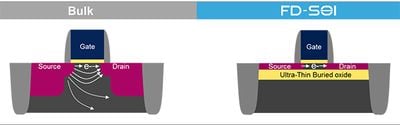
en.bulk_fd_soi_logo
The additional benefits of this process lie in the ability to dynamically control the transistor switching performance by way of biasing the transistor body. This can also be done in traditional bulk type semiconductors, but at the cost of impacting leakage performance. In the case of FD-SOI transistors, the effect is that the performance of the transistors can be modulated in real time.

Modern chips already feature multiple forms of dynamic frequency and voltage scaling (DVFS), but the ability to control FD-SOI transistors is even greater through the use of forward body biasing. Transistors can be dynamically controlled to switch faster by modulating the amount of voltage that must be applied to the device gate to effectively form a channel to operate the transistor.
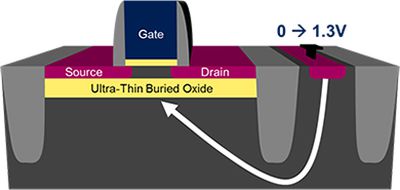
FBB
This dynamic control between forward and reverse body biasing means that the transistors can be operated at extremely low voltages, near the threshold point. Operating at as little as 0.5V, power use can be drastically reduced as device power is often directly correlated with the square (or cube) of applied voltage.
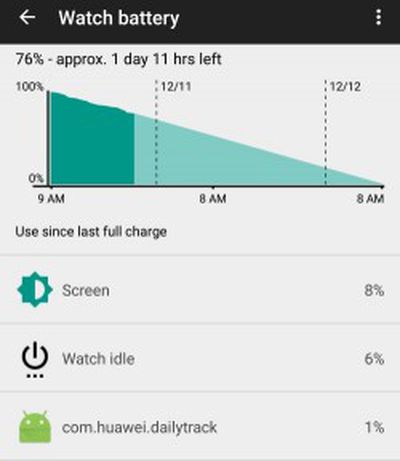
android_watch_batteryThe reason this technology is significant for wearables is because the main system on a chip (SoC) can play such a large part of the device's power consumption, particularly when most usage is idle, as shown in the Android-based example to the right. Reviews have shown that the wrong SoC can absolutely kill a smartwatch's battery performance. The other large factor in a smartwatch's battery usage would be the screen - a component where Apple is much more at the direct mercy of its vendors to provide an acceptably performing product.

Rapid design turnaround from Apple's processor groups, in addition to simultaneous launches of the A9 SoC on competing FinFET processes, show that Apple has the technical bandwidth to commit to introducing an additional design process into its mixture. In fact, we know that the original S1 SoC featured in the debut Apple Watch was manufactured on Samsung's 28nm LP process, in contrast to the leading 20nm process which would have been available at the time.

It is not unreasonable to think that Apple could make a somewhat lateral move to adopt Samsung's 28nm FD-SOI process, which is available now. Further down the road is the possibility of a 22nm FD-SOI process, and the technology will no doubt continue to grow if the market proves the demand as time goes along.

FD-SOI also has tremendous promise for analog and RF circuit applications due to its low leakage characteristics. It would not be a surprise to see RF front-end suppliers such as Qualcomm adopt FD-SOI for their modem and multi-band amplifier applications, and should Apple's hiring of engineers with RF expertise ever come to fruition, it would be a suitable candidate for more custom parts directly from Apple. In any event, do not be surprised if analyses of the next Apple Watch have a few surprises in store when the teardown firms get their microscopes out.


Related Roundup: Apple Watch 12
Tag: FD-SOI
Buyer's Guide: Apple Watch (Buy Now)
Related Forum: Apple Watch

Popular Stories

apple watch series 3 design

Apple Offers Steps to Fix Daylight Saving Time Bug on Apple Watch

Sunday November 1, 2026 3:34 am PST by
Apple has published a support document describing what to do if your Apple Watch continues to show time that's off by one hour after daylight savings time changes. "This incorrect time appears only on the Always On display when your wrist is down," says Apple. "When you activate the display by tapping it or raising your wrist, the time changes to the correct hour." To fix the issue, Apple says ...
siri recap live rewind

watchOS 27.3 Brings Live Rewind and Siri Recap to Apple Watch

Tuesday November 3, 2026 10:35 am PST by
With the first beta of watchOS 27.3, Apple is introducing new Audio Intelligence features it previewed for the Apple Watch Series 12 and Ultra 4 earlier this year. Powered by the S11 chip, Audio Intelligence includes Live Rewind, Siri Recap, Sound Recognition, and Shazam Music Recognition. Sound Recognition and Shazam are already on the watch, but Live Rewind and Siri Recap are now available ...
apple watch series 3 design

Apple Watch Users in Europe Report Daylight Saving Glitch

Monday October 26, 2026 5:26 am PDT by
Some Apple Watch users running watchOS 27 are reporting a daylight saving glitch after clocks went back in the UK and Europe on Sunday. In a MacRumors forums thread, five users – several in the UK and central Europe – say their watch shows the correct time when activated, but the Always-On display keeps showing summer time, leaving it an hour fast. The problem has also been reported in...


Top Rated Comments

JeffyTheQuik Avatar
134 months ago
As transistors begin to reach their physical size limits in modern semiconductor processes
In 26 years in the semiconductor industry (OK, 19 in the industry, and 7 in aerospace), how many times I've heard sentences start that way, and 3 years later, then laughed at the changes that ingenuity has wrought since that statement was written.
Score: 5 Votes (Like | Disagree)
134 months ago
the difference is the days you don't or forget to or are out and about without a charge
On days that I forget to charge the AW (e.g., I fall asleep on the couch), the AW battery is small enough that I can easily charge it while getting ready in the am.
Score: 2 Votes (Like | Disagree)
KylePowers Avatar
134 months ago
Nice technical article for a change.

Would like to point out that GloFo has a 22nm FD-SOI available as well.
Score: 2 Votes (Like | Disagree)
134 months ago
While I understand how you can see that battery life isnt an issue, many of us want a watch that we can wear and not need to charge every day.
"Many of us want a phone that we can use and not need to charge every day."
- A dumbphone owner circa 2007
Score: 2 Votes (Like | Disagree)
JoEw Avatar
134 months ago
Agreed... I keep thinking that we'll find a way to use electron spin and subatomic particles to further the law.

The thing that impressed me was the growing of transistors on layers other than the Silicon base layer. That lets the chips go where they never have gone before: vertical. In that way, the lines can be shorter (instead of having the RAM farm in a certain area, it can just be above the processing area).

Now, as an outsider, it's interesting to see what the engineers come up with, and I know they have the pressure to keep Moore's law.
[doublepost=1470853256][/doublepost]
So, what is stuff made of?
~400 BC - Atomos - Democritus
~350 BC - Earth, Wind, and Fire Aristotle (a fan of disco). Oh yeah, Water left the band early to go solo.
1869 - Atoms of different weights - Mendeleev
1897 - Electrons and other stuff - Johnson
1911 - Electrons and Protons - Rutherford
1913 - Electrons are particles that orbit the nucleus of Protons - Bohr
1926 - Electrons move in a wave form - Schrodinger (and his cat... or not)
1931 - Electrons, Protons, and Neutrons - Chadwick/Rutherford
1964 - Crap... Protons, and Neutrons are made up of other stuff... What about electrons? NO! (well, maybe no) - Mann/Zweig
2017 - ???
Sources:
http://particleadventure.org/scale.html
http://cstl-csm.semo.edu/cwmcgowan/ch181/atomhist.htm
http://www.softschools.com/timelines/atomic_theory_timeline/95/

The point I'm making is that at each point, there is the question, "how far down can we go?" and there is always one (or more) discoveries that moves that wall. I'm just open to the possibility that there is something else, while keeping in mind the laws of Nature (including subatomic Nature) that are already discovered.

As a side note, when we try to predict how things will turn out, even on things that have no "choice" in the matter, we have to predict how each of those particles will behave. That, in the context of the Chaos Theory, makes everything just a good (or not) guess. All of the wisest people that I've talked to on the subject were the first to admit that what we know would fill a library. What we don't know fills the rest of the universe.
[doublepost=1470853421][/doublepost]
Agreed. In the post above, I put why predicting nature is hard, and predicting individual humans and groups of them is even more difficult. Just look at the 2016 choices: Bad, and Worse. Who is who depends on your point of view...
It may be possible to go smaller, but to keep with the economics of Moore's law is just not realistic with current silicon production methods, Intel added another 14nm stepping for this reason. It's not hard to see we are hitting a limit here.
Again my argument is with current silicon based CPU production within 10 years it'll
1. be too expensive to shrink transistors further
2. even then eventually quantum tunneling is unavoidable

A different fab method which will cost untold billions in R&D and construction of new fab processes will be the end of Moore's law.
I have no doubt will find clever ways around this issue but it's not going to be cheap and it will radically shift the technology sector since everything has been possible because of Moore's law. What happens if CPU's suddenly cost double what they use to?
Score: 1 Votes (Like | Disagree)
134 months ago
In 26 years in the semiconductor industry (OK, 19 in the industry, and 7 in aerospace), how many times I've heard sentences start that way, and 3 years later, then laughed at the changes that ingenuity has wrought since that statement was written.
You're right, there's always been a constant 'we're reaching the end/limits of lithography and Moore's law' but now it really is getting to its limits. Beyond 5nm which is only a couple generations away it really stops being feasible both physically and economically to go any smaller. I have absolute faith technology won't stop and things will keep pushing forward with stacked transistors, better chip design, new cooling techniques, different semiconductor materials, better efficiency, higher frequencies and so on. But the days of shrinking transistors is coming to an end, we will just change directions. NAND flash cells are evolving in new ways with vertical stacking for example rather than shrinking them. 14>10>7>5 will probably be about the limit. Even the latest reports don't believe we can keep going much beyond that. But ingenuity and huge demand will create new solutions.
Better multithreaded programming really needs to keep improving too.
Score: 1 Votes (Like | Disagree)
Latest Stories
Apple Store Subscription Sign-Up Controversy Exposed
7 hours ago
Siri AI Rumored to Become 'More Like an Agent' as Early as Next Year
17 hours ago
Apple Taking New Approach to Developing iOS 28 and macOS 28
18 hours ago
Early Apple Black Friday Deals on Apple Watch, MacBook Air, and More
2 days ago
'Backglow' Lets You Customize New MacBook Pro's Glowing Apple Logo
2 days ago
Top Stories: Apple Product Launches, iOS 27.3 Beta, and More
2 days ago
More Fun iPhone Duo Apps: 30 New Picks to Try
2 days ago
Hands-On With Apple's New OLED Touchscreen MacBook Pro
3 days ago
Apple Store With All-New Design Opening Soon in Southern California
3 days ago
Control the Glowing Apple Logo on Your New MacBook Pro
3 days ago
Apple Shares New 'Apple Card: Apply and Use in Minutes' Ad
3 days ago
Apple Says More Than 100,000 Apps Optimized for iPhone Duo, Here's What's Still Missing
3 days ago
Early Black Friday Deals Kickoff With Steep Discounts on Apple Watch Ultras and More
3 days ago
The MacRumors Show: iOS 27.3 Looks Like a Huge Update
3 days ago
Best Buy's Black Friday Event Begins With Sitewide Savings on Apple, TVs, More
3 days ago
Apple Releasing Yet Another Two New Products Next Week
3 days ago
MacBook Air Drops to Lowest Price in Months With Amazon's $250 Discount
3 days ago
Apple Rumored to Drop the iPhone's Action Button Next Year
3 days ago
Apple's Extended Return Policy Now in Effect for 2026 Holiday Season
3 days ago
Apple Music Classical Updated With New Icon and Refreshed Design
3 days ago
OLED iPad Mini, M6 iMac, and New MacBook Pros Available From Today
3 days ago
Apple Surveys iPhone Duo Buyers About Crease and Camera
3 days ago
Apple's First Touchscreen Mac is Now Arriving to Customers
3 days ago
Claude Gets Personal Finance Feature With Bank Account Linking
3 days ago
Apple Arcade Adds Crossy Road Rush and NBA 2K27
4 days ago
Apple's New HomeView Smart Home Hub: Here's How Much RAM It Has
4 days ago
iPad Mini vs. iPad Air Buyer's Guide: Now Just $50 Apart
4 days ago
First iOS 27.3 and macOS Golden Gate 27.3 Public Betas Now Available
4 days ago
Apple Announces a New Mac Sales Record
4 days ago
Paid $200 for Logic Pro? Apple Says You Won't Get This New Feature
4 days ago