

A new patent filed by Apple in 2015, and published today by the United States Patent and Trademark Office, shines some light on what the company could be working on in regards to sleep tracking technology and its recent acquisition of Beddit. Called "Adjusting alarms based on sleep onset latency," the new patent describes in detail a system that could receive data from devices like an iPhone, Apple Watch, or a Beddit-like flat, flexible sensor, and intelligently track user behavior to help them get their best night sleep possible (via AppleInsider).
The patent explains that most people have typical bedtime habits recurring every night, such as going to the bathroom, shutting blinds, taking a shower, etc. These "sleep ritual activities" directly affect each person's "sleep onset latency," or the amount of time it takes you to fall asleep after first lying down and attempting to go to sleep. The problem with most modern alarm apps is that they can't understand a restless night's sleep, or a lengthy sleep onset latency period, and Apple's new patent tries to address these issues.
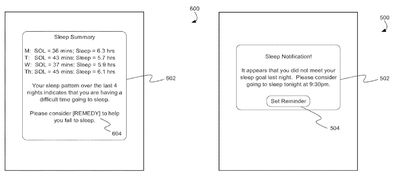
The first step is for the sensors to determine your sleep ritual activities, and Apple's patent has a few ways to go about doing that. One is by using sound data, so when the device detects someone brushing their teeth, taking a shower, "or any other activity that generates an identifiable or unique sound," the sleep tracking system can start accumulating data for that night's sleep because it knows you're about to try to rest. Other tips related to sleep rituals for Apple's sleep tracking system include user movement, light/dark levels in a room, and even app usage.
In some implementations, sleep logic can identify sleep ritual activities based on application usage. For example, the user may have a habit of using specific software applications installed on computing device immediately before going to bed. The user can check calendar application. The user can set a wake up alarm using alarm clock application.
The user can use social media applications, news applications, a game application, an e-book reader application, and/or other applications before going to sleep. Sleep logic can monitor application usage before the predicted sleep time (e.g., 1 hour before, 0.5 hour before, etc.) and determine which applications the user uses before the user's predicted sleep time. Sleep logic can store the detected application use activities as sleep ritual activities in sleep ritual database.
Taking this information into account, once you actually try to go to bed, the sleep tracking system will begin looking at how long it actually takes you to fall asleep (heartrate and breathing are mentioned), remembering your sleep ritual activities and calculating how they affected your sleep onset latency. Apple's theoretical system would also understand when you're obviously not asleep, like if you're currently on your iPhone on another connected device, and adjust tracking accordingly.
All of this data then feeds into how the system would be able to automatically adjust pre-set alarms because of a potentially inconsistent sleep pattern. The basic idea of the patent simply adds on sleep latency duration to the following morning, so if the system tracked that it took you 45 minutes to fall asleep, and you have an alarm for 7:00 AM, it would wake you up at 7:45 AM.
Of course, that risks some users getting a later start on their day than they are comfortable with, so Apple's patent has a wide range of features that can prevent you from not waking up later than you intend to. The system would recognize calendar data, so if you have an appointment at 7:30 AM, your 7:00 AM alarm wouldn't be adjusted. Likewise, travel time to your first appointment of the day would be taken into account.
Similar to nighttime rituals, the system is said to also track how long your morning rituals last over time. Using this data, it'll also be able to figure out the best wake up time, so if you have a long morning ritual, your alarm might go off earlier than someone whose morning ritual is faster. Over time, all of the data gathered by the sleep tracking system would help users "feel more rested" throughout their day, according to Apple's new patent.
Particular implementations provide at least the following advantages: the mobile device can help the user feel more rested by automatically adjusting an alarm or suggesting an earlier bedtime based on the determined sleep onset latency to ensure that the user gets enough sleep; the mobile device can automatically determine sleep onset latency using various sensors of the mobile device; the mobile device can automatically identify sleep patterns that may be adversely affecting the user.
Additionally, Apple's patent even discusses an in-depth "nap function" for sleep tracking. In the user interface (seen below, image right), you would set up a nap schedule, determine when you want to wake up, and press and hold on the iPhone's display to begin your nap. The system would know the sleep onset latency because of this applied pressure, so when you first apply your finger to the display, it'll know the period has begun, and when you begin to release pressure (i.e. doze off), it knows you've begun napping.
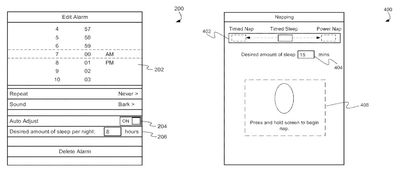
An alternative "power nap function" describes a way for a device -- here a "wearable device such as a watch" is specifically mentioned -- to wake you up when the system determines that you've entered and stayed in a deep sleep for a period of previously-determined time. After figuring out when your heart rate and breathing rate have reached the "deep sleep threshold" for a period of time, the system would begin waking you up, so you can "realize the benefit of sleep without the grogginess that is experienced when a user is awakened from a deep sleep."
The specific kinds of sensors referenced in the patent -- including light- and sound-based sensors -- are implemented in modern iPhones, but it's unclear whether a sleep tracking system described in today's patent would simply be an addition to an existing Apple device, a new iteration of a product like Beddit, or a combination of both. Apple slowly began expanding its sleep tracking support with "Bedtime" in the iOS 10 Alarm app, but that feature simply tracks the hours between when a user manually inputs a bedtime and when they silence the morning alarm, with no ability to understand how long the user is actually sleeping.
Of course, it's still unclear exactly what Apple intends to do with Beddit's technology, and today's patent comes with the usual warning to take everything detailed in it with a grain of salt. For a closer look at Beddit, check out the technology behind the flexible sensor, as well as our own review of Beddit's sleep monitor.











Top Rated Comments
This is 1984 . The biggest company in the world knows when you're alseep.