Fitbit Announces Deal to Bring Glucose Monitoring Data to its Ionic Smartwatch - MacRumorsOpen MenuShow RoundupsShow Forums menuVisit ForumsOpen Sidebar
Skip to Content

Fitbit Announces Deal to Bring Glucose Monitoring Data to its Ionic Smartwatch

Fitbit has announced a new partnership with glucose monitoring device company Dexcom that is set to bring diabetes monitoring capabilities to the fitness tracker company's new Ionic smartwatch.

The deal initially means Ionic users will be able to connect a Dexcom device to the Fitbit app and seamlessly transfer up-to-date glucose level data to the smartwatch, making the information more easily accessible on their wrist.
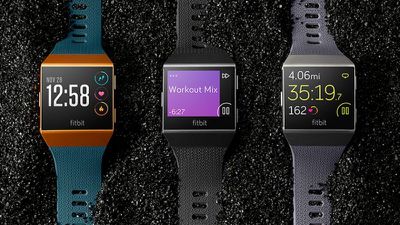
fitbit iconic

"The collaboration between Dexcom and Fitbit is an important step in providing useful information to people with diabetes that is both convenient and discreet," said Kevin Sayer, President and CEO, Dexcom. "We believe that providing Dexcom CGM data on Fitbit Ionic, and making that experience available to users of both Android and iOS devices, will have a positive impact on the way people manage their diabetes."

There's nothing in the partnership to suggest the Ionic smartwatch will be able to give continuous glucose monitoring readouts on its own when it's released next month – current continuous glucose monitoring systems require a small sensor that's worn under the skin to monitor glucose levels – but Fitbit shares jumped 13 percent on the news, a high for the company since January, when it laid off some of its employees and announced its smartwatch plans.

Dexcom also has a deal with Apple to bring its features to the Apple Watch this year, while owners of Dexcom monitors can already view their glucose data on an Apple Watch – advanced devices by Dexcom include a transmitter, which can display glucose information directly to an iPhone app.

Apple is thought to be working on a non-invasive real-time glucose monitor for a future version of Apple Watch. In April, a CNBC report suggested Apple had a team of biomedical engineers working to develop sensors for non-invasively monitoring blood glucose, with work on the sensors far enough along that the company had started conducting feasibility trials.

Apple CEO Tim Cook was reportedly spotted in May testing a prototype glucose monitor that's connected to his Apple Watch. Cook, who is said to be aiming to understand how his blood sugar is affected by food and exercise, has been seen wearing the device around the Apple Campus.
Related Roundup: Apple Watch 11
Tags: Dexcom, Fitbit
Buyer's Guide: Apple Watch (Caution)

Popular Stories

apple watch ultra 3 1

Apple Now Requires UNiDAYS Verification for Education Discounts in U.S. and Canada, Adds Apple Watch

Friday May 8, 2026 3:00 am PDT by
Starting today, Apple will require customers in the U.S., Canada, and Chile to verify their status as a student or educator to get educational discounts. Apple is adopting the UNiDAYS verification system that it uses in other countries, with a new process to accommodate homeschool families. Apple is also adding the Apple Watch Series 11, Apple Watch SE, and Apple Watch Ultra 3 to its...
Apple Watch Series 10 Jet Black Touch ID

Apple Watch Series 12 and watchOS 27: What to Expect Later This Year

Friday May 8, 2026 2:07 pm PDT by
While not too much has been reported about the next Apple Watch models, there are a few rumors about potential design changes and watchOS 27 features. Apple Watch Series 12 and Apple Watch Ultra 4 models are expected to be released in September, and we have outlined some of the key rumored hardware and software changes below. A new Apple Watch SE is not expected this year, as that model was...
Apple Watch Series 10 Jet Black Touch ID

Next Apple Watch Models Unlikely to Add Touch ID, Focus on Battery Life

Monday May 11, 2026 3:41 am PDT by
Apple is prioritizing larger batteries and more advanced health sensors over fingerprint authentication for the Apple Watch, according to a new claim from a prominent Chinese leaker. In a new Weibo post, Instant Digital pushed back on recent speculation about biometric recognition coming to Apple's wearable lineup, claiming instead that the company remains content to let users unlock their...

Top Rated Comments

Chupa Chupa Avatar
114 months ago
It would be Great if one day smart watches could also accurately detect heart problems before a heart attack occurs.
Long way to go there. Right now optical HRMs (all, not just the AW) cannot detect electrical heart activity. Optical HRM can only detect pulse based on light transmitted though blood. That is why the AW HR data (and other optical based watches) are inferior to those that require a chest strap for data collection. Optically gleaned data:2D, chest straps:3D.
Score: 3 Votes (Like | Disagree)
thisisnotmyname Avatar
114 months ago
Not Earth-shattering news here, although those who frenzied to buy Fitbit shares didn't appreciate that. The Fitbit will show the data of another device, just as AppleWatch can. Accurate real-time blood glucose monitoring, on the other hand, will be a game changer.
The downside is that if someone were to make non-invasive real time glucose metering accurate and incorporate it natively into, say, the Apple Watch, then every update to WatchOS from the point forward would require FDA approval. It's a bureaucratic nightmare which makes me think they'd want to isolate it in some way (e.g. a band with its own reporting/display mechanism that then uses BT to send to the watch for redundant archival, someone focusing to this area of regulation could weigh in but I believe that lowers the bar then).
Score: 3 Votes (Like | Disagree)
Kabeyun Avatar
114 months ago
Not Earth-shattering news here, although those who frenzied to buy Fitbit shares didn't appreciate that. The Fitbit will show the data of another device, just as AppleWatch can. Accurate real-time blood glucose monitoring, on the other hand, will be a game changer.
Score: 3 Votes (Like | Disagree)
Sunny1990 Avatar
114 months ago
It would be Great if one day smart watches could also accurately detect heart problems before a heart attack occurs.
Score: 3 Votes (Like | Disagree)
114 months ago
It's still invasive, unlike the sensor Apple have been testing.

I'm tired of hearing news like this and Google's AR efforts. Just enough to steal the sheen from Apple but not better, or even as good as Apple products.

I would love Apple to leapfrog others. Completely smash it out of the park like the gap which existed between iPhone 4S and any Blackberry phone in 2011.
Score: 2 Votes (Like | Disagree)
Chupa Chupa Avatar
114 months ago

2% variance from better monitors isn’t bad at all.
No I don't think you understand the difference between the two technologies. I am not talking about simple pulse. I'm talking about electrical activity, similar to what an EKG does. (Obviously EKGs are medical grade and consumer chest straps are not.) But optical HRMs -- no matter what brand because it's not about brand it's about the technology -- cannot detect electrical activity. There currently is no way to derive heart rate variability (HRV) from an optical sensor -- again regardless of brand.

But yes, if you are training 2% can be the difference from thinking you are in one zone or another -- a zone you don't want to be in. If you don't do heart conditioning then 2% doesn't matter obviously. So it depends what your use it. 2% can be significant and is why people serious about heart conditioning do use a strap.
Score: 1 Votes (Like | Disagree)