Intel says the Ice Lake chips have increased board integration, allowing manufacturers like Apple to release notebooks with sleeker designs. The chips also feature Intel's all-new Gen11 graphics architecture for up to double the graphics performance, and integrated Thunderbolt 3 and Wi-Fi 6, aka 802.11ax.
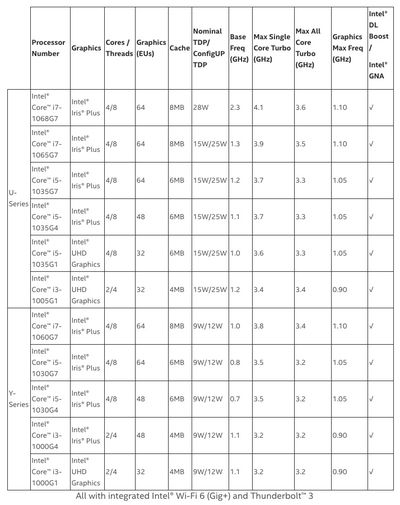
The lineup of 11 new processors includes six U-series chips and five Y-series chips:
Intel is also introducing a new processor number naming structure starting with this first set of 10th-generation Core processors, doing away with Y and U series identifiers and instead emphasizing graphics. The new structure is a bit confusing, but The Verge has a nice breakdown for deciphering them.
Intel expects the first notebooks with Ice Lake chips to be available in time for the holiday shopping season.
Tuesday September 1, 2026 4:50 pm PDT by Juli Clover
Apple today informed developers that universal Mac App Store apps that require macOS 13 or later can remove support for Intel-based Mac computers.
We're reaching out to let you know that universal macOS apps on the Mac App Store that require macOS 13 or later can now remove support for Intel-based Mac computers.
By removing support for Intel-based Mac computers, you can simplify your...
Tuesday September 15, 2026 12:53 pm PDT by Juli Clover
Apple today added the 2019 4K iMac to its list of vintage products, which means repairs can only be done if Apple has the parts available.
Products are added to the vintage list five years after they were last distributed for sale, and they're moved to the obsolete list at the seven-year mark. Vintage products can be repaired at Apple Stores and by Apple Authorized Service Providers if the...
Apple memory supplier SK Hynix is in exploratory talks with Intel about manufacturing memory chips in the United States for the first time, according to Reuters.
One option would see the South Korean chipmaker lease part of Intel's planned manufacturing complex in Ohio. Another would involve a joint venture with Intel and major cloud providers seeking to secure memory supplies, people...
This CPU line-up is probably as good a clue as any as to why the 12-inch MacBook was killed (for now). The 2015 MacBook launched with a 4.5W Y-series CPU. Last year's Y-series CPUs then went to 5-7W. Now we're at 9W. Apple designed a laptop based on the assumption — presumably promised as such by Intel — that Intel would keep iterating on a roughly 4.5W TDP CPU, and they failed to do so, even after this process shrink.
700MHz base clock. What decade century is it again?
This is good, actually. Low clock rates means Intel has some breathing room for future generations at the same process size to offer more performance simply by cranking up the clock rate.
Which TDPs are MacBook pro compatible? All of them?
9W: probably the MacBook Air (which is currently at 7W, but presumably Apple has learnt the lesson not to trust Intel on that).
15W: low-end 13-inch MacBook Pro.
28W: possibly the higher-end 13-inch MacBook Pro, but Apple probably wants more options for that. Also, this CPU model won't ship for a while.
Critically, none of these are even remotely an option for the 15-inch (16-inch?) MacBook Pro, which likely won't see another CPU upgrade until Comet Lake-H in Q2 2020. It'll offer up to ten cores, but it will still be at 14nm and still use a revised Skylake architecture. Still no LPDDR4, even.
Can't come soon enough the day that Apple can engineer some A-series chip and release upgrades when the Mac, not Intel, are ready. I could see the MacBook line getting resuscitated as a canary for this