Samsung Aiming to Supply OLED Displays for Both iPads and MacBooks - MacRumorsOpen MenuShow RoundupsShow Forums menuVisit ForumsOpen Sidebar
Skip to Content

Samsung Aiming to Supply OLED Displays for Both iPads and MacBooks

Samsung is planning to build a new production line in South Korea to make larger OLED displays suitable for tablets and notebooks, with the company ultimately aiming to fulfill orders for future Apple products, according to The Elec.
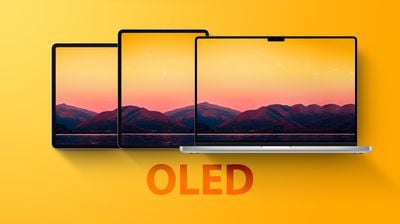
Oled iPads and MackBook Pro Notch
The Elec previously reported that Apple plans to release its first iPad Pro models with OLED displays in 2024 and said that Samsung would produce displays for those models at one of its existing lines. Samsung's future production line would be located at a different factory and be capable of creating OLED displays large enough for notebooks, paving the way for a MacBook Pro with an OLED display, which is rumored to launch in 2025 or later.

Apple has been transitioning its iPad and MacBook lines to mini-LED displays over the last year, and OLED would be the next step after that. Unlike mini-LED displays, OLED panels use self-emitting pixels and do not require backlighting, which could improve contrast ratio and contribute to longer battery life on future iPad and MacBook models. Apple already uses OLED displays for its latest iPhones and all Apple Watch models.

In the meantime, Apple is rumored to be planning more devices with mini-LED displays, including a new 27-inch monitor that could essentially be a Studio Display Pro.
Popular Stories

MacBook Pro Low Angle Wide Lens 2

MacBook Pro OLED Display Production Clears Key Hurdle

Thursday May 21, 2026 1:41 am PDT by
Apple's first OLED MacBook Pro models have cleared a major manufacturing hurdle, with panel supplier Samsung Display having reportedly achieved yields above 90 percent on its Gen 8.6 OLED production line. According to Korean publication The Elec, some individual process stages are now reaching yields as high as 95 percent, a level that the display industry considers "golden yield" territory ...
Apple Watch Ultra 3 hero 250909

2027 Apple Watch Could Adopt Next-Generation OLED Display Tech

Tuesday June 2, 2026 3:36 am PDT by
Apple is evaluating a new OLED display backplane technology that could make future Apple Watch models more power efficient, according to a new report from Korean publication The Elec. LG Display is said to be developing high-mobility oxide, or HMO, thin-film transistor technology for its sixth-generation small and medium-sized OLED production lines. The technology is reportedly being...
iphone 18 pro blue%402x

iPhone 18 Pro: Dark Cherry, Light Blue, and Dark Gray Chassis Leaked [Update]

Thursday June 4, 2026 5:18 am PDT by
Update: Since publication, new information has come to light suggesting the images have been AI-manipulated and are not in fact iPhone 18 Pro chassis parts. The original article follows. The color options Apple is reportedly planning for the upcoming iPhone 18 Pro and ‌iPhone 18 Pro‌ Max have appeared online today in the form of images of chassis parts of unknown authenticity....

Top Rated Comments

FightTheFuture Avatar
52 months ago

What would Apple be without Samsung and TSMC?! 🤣
Or Corning, or Qualcomm, or Sony, or Amperex, or Kioxia, or...
Score: 9 Votes (Like | Disagree)
Wildkraut Avatar
52 months ago
What would Apple be without Samsung and TSMC?! 🤣
Score: 7 Votes (Like | Disagree)
52 months ago

Difference?
Its been a few months since I last watched videos on the technology and how it was comparing. Alienware has the first commercial monitor based on it and has a no burn-in guarantee.

Basically, one of the traditional ways of doing OLED was a white OLED panel that goes through a color filter. This filter loses brightness, so they add a 4th pixel of white to add luminosity.

QD-OLED uses a blue OLED panel with quantum dots in front that absorb and re-emit photons in red and green. The blue that comes through is the original blue from the back panel. Its brighter than using a color filter, which means the actual OLED panel isn't driven as hard, which means you aren't pushing into burn-in territory (theoretically)...and you don't need a 4th pixel. They also use 3 layers of Blue OLED to get the full brightness, again, reducing the wear and tear that turns into burn-in.

LTT had some videos both on the tech and reviewing the Alienware monitor.
This is a pretty long comparison of multiple display technologies, QD-OLED starts about a third of the way down.
https://www.digitaltrends.com/home-theater/qd-oled-hybrid-display-technology-fully-explained/
Score: 6 Votes (Like | Disagree)
NBAasDOGG Avatar
52 months ago

If its regular OLED, then no, I would refuse to buy it.

If it is QD-OLED, then I think thats a good choice.
And the good news is, Samsung is the company behind QD-OLED.....so there is hope Apple is going with the better technology.
What do you mean with regular OLED? W-RGB or Pentile OLED?

In case you’re wondering, current pentile OLEDs in smartphones have already outperformed QD-OLED before QD-oled even existed.
Score: 6 Votes (Like | Disagree)
one more Avatar
52 months ago
Great news, IMO, as Samsung make the best OLED panels out there.
Score: 5 Votes (Like | Disagree)
Realityck Avatar
52 months ago
I actually like the current miniLED displays on 14/16 MBP’s so yeah maybe only the iPad Air and MBA as you say.
Score: 5 Votes (Like | Disagree)