Apple Explores iPhone 'Privacy Screens', Macs With Adjustable Viewing Angles - MacRumorsOpen MenuShow RoundupsShow Forums menuVisit ForumsOpen Sidebar
Skip to Content

Apple Explores iPhone 'Privacy Screens', Macs With Adjustable Viewing Angles

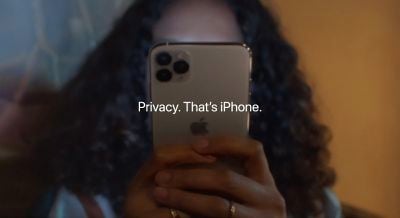
Earlier this year, The Wall Street Journal published an in-depth report highlighting instances of thieves watching iPhone owners enter their passcode before stealing the device in order to gain access to the device, data, and money.
appleprivacyad cleaned
With knowledge of the iPhone's passcode, a thief can easily reset the victim's Apple ID password in the Settings app, even if Face ID or Touch ID is enabled. It also allows a thief to use Apple Pay, send Apple Cash, and access banking apps using passwords stored in iCloud Keychain.

"We sympathize with users who have had this experience and we take all attacks on our users very seriously, no matter how rare," said Apple in response to the report. "We will continue to advance the protections to help keep user accounts secure."

Apple did not provide any specific details about any next steps it might take to increase security, but there are indications that Apple may be seeking a hardware solution to scupper the scourge of so-called "shoulder surfers."

Current displays on Apple devices provide a 170-degree field of view, making it easier for others to glance at your iPhone, iPad, or Mac screen. To counter this, two new patents by Apple propose innovative solutions to restrict screen visibility to just the user.

The first patent, "Privacy Films for Curved Displays," introduces a special screen covering that limits light emission to a single direction.

Positioned directly in front of the screen, the user is witness to the display's full quality and optimal brightness. However, onlookers attempting to peek from even a slight angle to the left or right of this position are not so lucky, and see either a completely obscured view or, more likely, a blurred image.

The second patent, "Displays with Adjustable Angles of View," is designed for flat screens, and describes how a user could adjust a Mac's viewing angle in real-time to act as a filter.

In one embodiment, the user is able to control the screen's polarization using an array of adjustable louvres, effectively limiting visibility from side-on viewing angles and increasing the privacy of onscreen content. The patent also describes how a liquid crystal element could be used that restricts the visibility of certain colors when the screen is not viewed directly.

As with any filed patent, the technology is unlikely to appear in any product soon, if at all, but it does offer an interesting look at how Apple is considering ways to overcome privacy issues when users access their devices in public spaces.

Until such a time, users can adopt best practices for their own smartphone privacy, such as switching from a four-digit passcode to an alphanumeric passcode, which is more difficult for thieves to spy on. This can be done in the Settings app under ‌Face ID‌ & Passcode → Change Passcode.

(Via AppleInsider.)
Tag: Patent

Popular Stories

Apple Card iPhone 16 Pro Feature

Apple Card Promo to Offer Free AirPods Pro 3

Friday May 15, 2026 8:59 am PDT by
Starting as early as next week, customers who sign up for an Apple Card at Apple's retail stores in the U.S. will receive $249 cash back when they purchase AirPods Pro 3, according to Bloomberg's Mark Gurman. The promotion has yet to be officially announced by Apple, so exact terms and conditions are not available at this time. AirPods Pro 3 are priced at $249 in the U.S., so customers who...
Apple WWDC25 iOS 26 CarPlay Light mode 250609

Six Popular iPhone Apps Now Available on CarPlay

Thursday May 14, 2026 9:10 am PDT by
Apple's CarPlay system for accessing iPhone apps on a vehicle's dashboard screen has received six popular apps in recent weeks: ChatGPT, Perplexity, Grok, Google Meet, WhatsApp, and the indie artist streaming platform Audiomack. Make sure you have the latest version of each app and they will automatically appear on CarPlay. ChatGPT Starting with iOS 26.4, CarPlay supports voice-based...
ipad mini 7 blue

OLED iPad Mini: Release Date, Pricing, and What to Expect

Thursday May 14, 2026 5:08 am PDT by
According to the latest rumors, Apple is close to launching its next-generation iPad mini. So what should we expect from the successor to the iPad mini 7 that Apple released over a year ago? Read on to find out. Processor and Performance Apple is working on a next-generation version of the iPad mini (codename J510/J511) that features the A19 Pro chip, according to information found in code...

Top Rated Comments

RichP Avatar
32 months ago
It would make for an interesting feature if adjusted by software. Have the lock screen/ passcode entry with a very narrow viewing angle, then once the phone is unlocked then the full viewing angle is enabled. Could also do this on an app/ function basis. Bank app? Narrow. Watching a video? Full.
Score: 18 Votes (Like | Disagree)
32 months ago
It seems like after that report came out it would have been rather trivial to offer an option to randomize the numberpad each time you use it. And/or allow an option to disable resetting the Apple ID password from the Settings app. They can reinvent the wheel down the line, but there are practical, easy to deploy solutions available now.
Score: 12 Votes (Like | Disagree)
32 months ago

This would prevent people from seeing the contents on your screen, and for that it could be useful. Of course, I would want this to be optional, since most of the time I am the one who wants to look at my phone from an angle. It is placed to the side on my desk while I work on the desktop, and I often glance at the AOD for the notifications and what not.

But it might make it only marginally more difficult to learn your passcode since the person watching you is also looking at your finger, not just the screen. Tapping only six numbers on a big keypad makes it obvious what numbers you are tapping. So I think that issue demands a separate solution.
Apple really needs to stop allowing the Apple ID to be reset with the phone passcode.

I sympathize with them, because when I'm supporting users the question I dread asking them the most (and usually the only question I can't find the answer to on my own) is: what's your password?

Blank look. Pulse quickens. "uh..password? what password?" They then enter the same two passwords they use with sixty different services. They don't even know what account they're trying to log in to. But it still doesn't work.

So they choose reset. Every single time. They enter the same password with a different number at the end. And then they promptly forget this whole unpleasant incident ever happened, setting the stage for it to happen again.

I know Apple's support costs would skyrocket, but it's unfortunate that people who can keep up with their passwords have to suffer a fundamentally insecure system because the vast majority of users never had any education on basic computer usage.
Score: 9 Votes (Like | Disagree)
32 months ago

why would they do this?

these privacy screen protectors show that this is a bad idea, purposely reducing screen viewing angles is stupid.
You seriously think privacy is stupid?

whenever you want to show people something you literally have to hand them your phone.
My biggest pet peeve are people that insist that I look at what's on their phone. I literally don't care about your cat pics, or even worse when someone wants me to watch a video of unknown length while they hold their phone out.

"Nah, I'm good. I really don't need to see whatever it is."
Score: 7 Votes (Like | Disagree)
32 months ago
It's a hard problem. People who this happens to surely never imagined it could happen to them.

When it happens - it's too late to do anything about it.
Before it happens - you think it would never happen.
Score: 7 Votes (Like | Disagree)
32 months ago
Imo, changing your Apple ID password should be more difficult/secure, I am thinking maybe 2FA via another device. It shouldn't be this easy for any criminal.
Score: 7 Votes (Like | Disagree)