Apple M5 Chip's Dual-Use Design Will Power Future Macs and AI Servers - MacRumorsOpen MenuShow RoundupsShow Forums menuVisit ForumsOpen Sidebar
Skip to Content

Apple M5 Chip's Dual-Use Design Will Power Future Macs and AI Servers

Apple will reportedly use a more advanced SoIC packaging technology for its M5 chips, as part of a two-pronged strategy to meet its growing need for silicon that can power consumer Macs and enhance the performance of its data centers and future AI tools that rely on the cloud.
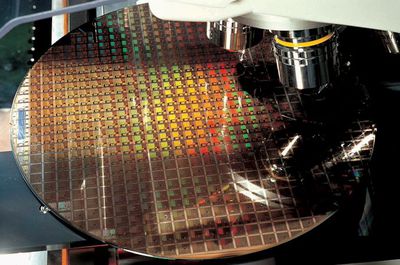
tsmc semiconductor chip inspection 678x452
Developed by TSMC and unveiled in 2018, SoIC (System on Integrated Chip) technology allows for the stacking of chips in a three-dimensional structure, providing better electrical performance and thermal management compared to traditional two-dimensional chip designs.

According to the Economic Daily, Apple has expanded its cooperation with TSMC on a next-generation hybrid SoIC package that additionally combines thermoplastic carbon fiber composite molding technology. The package is said to be in a small trial production phase, with the intention of mass producing the chips in 2025 and 2026 for new Macs and AI cloud servers.

References to what are believed to be Apple's M5 chip have already been discovered in official Apple code. Apple has been working on processors for its own AI servers made with TSMC's 3nm process, targeting mass production by the second half of 2025. However, according to Haitong analyst Jeff Pu, Apple's plans in late 2025 are to assemble AI servers powered by its M4 chip.

Currently, Apple's AI cloud servers are believed to be running on multiple connected M2 Ultra chips, which were originally designed solely for desktop Macs. Whenever the M5 is adopted, its advanced dual-use design is believed to be a sign of Apple future-proofing its plan to vertically integrate its supply chain for AI functionality across computers, cloud servers, and software.

(Via DigiTimes.com.)
Tags: M5, TSMC

Popular Stories

iCloud iPhone 17 Pro

iPhone Users Who Pay for iCloud Storage Get Two New Perks on iOS 27

Thursday July 2, 2026 6:10 am PDT by
If you pay for certain iCloud+ storage plans beyond the 5GB that Apple offers for free, you will receive two more perks on iOS 27 at no additional cost. A summary of the two new iCloud+ perks on iOS 27:Increased daily usage limits for some new Apple Intelligence features, including image generation in the revamped Image Playground app. HomeKit Secure Video cameras receive generated video...
iPhone 4 on Black Feature

Apple Facing One of Its Worst Leaks Since the iPhone 4

Thursday July 2, 2026 9:53 am PDT by
Apple supplier Tata Electronics recently suffered a cyberattack that resulted in thousands of confidential files being published on the dark web, and this reportedly included some photos and documents related to the upcoming iPhone 18 Pro. We have elected not to share any of the leaked photos in this story due to the illegal nature in which they were obtained, but they can easily be found...
American Express Gold Apple Pay Feature

American Express Announces New Apple Pay Feature

Tuesday June 30, 2026 10:27 am PDT by
American Express today announced that you can now redeem Membership Rewards points when checking out with Apple Pay on the web and in apps on the iPhone and iPad. When checking out with Apple Pay on iOS 18 or iPadOS 18 or later, tap on your eligible American Express card (Platinum, Gold, Green, and others) and select the Membership Rewards points option. You can use points to cover all or...

Top Rated Comments

bradman83 Avatar
26 months ago

This sounds like the theorized "Double Ultra" chips that would have been two M1 Ultra Chipsets stacked on top of each other, connected at the beltline interface between two Mx Maxs.


It's a bit more sophisticated than that. Right now a SoC has all of its components on a monolithic die - the CPU and GPU cores, the NPU, memory controllers, built in USB/Thunderbolt controllers, Secure Enclave, etc. What SoIC allows for is all of those SoC components to be split out and fabricated separately but then integrated back with each other with resulting performance that's actually better than a monolithic SoC die.

So instead of an Ultra being two Max chips being stitched together it could be a large CPU tile joined to a large GPU tile with smaller controller component tiles added on. All of the M series chips would be built this way, not just the Ultra. This would have the side effect of increased yields by making smaller and less complex chiplet dies, and allow Apple to focus limited bleeding edge process node capacity on important sections of the tiles like the CPU and GPU and have controller tiles manufactured on older but still efficient process nodes.
Score: 26 Votes (Like | Disagree)
26 months ago

Is Apple getting back into the server market?
"Server" covers a lot of different uses. I'm sure the focus will be on systems designed to drive AI and high-performance computing services - a booming requirement - rather than file sharing/email/web-hosting. ...but there is already stiff competition there, including power efficient ARM based systems. The competition will include AWS, who have their own ARM-based processors, and Nvidia's Grace Hopper ('https://www.nvidia.com/en-gb/data-center/grace-hopper-superchip/') chip (which is a good illustration of where multi-chip technology might come in).


They never left. The M1 Mac mini for $275 lightly used runs circles around the Xserves
There's a difference between hardware that can be used as a server - the Mac Mini - and a system designed specifically for datacentre applications - like the XServe. Datacentre systems have features nothing to do with the CPU, like

* being designed from the ground up for high density rack mounting (including layout and cooling)
* dual redundant power supplies (PSU failure is a onec-in-a-blue-moon a single personal computer, in a datacentre with hundreds of the things, it must be Thursday!)
* hot-swap/RAID disc drives (same logic as above)
* lights-out power management (for those times when you need to push the power button - again, same logic)

When the PPC XServe was released it had several Unique Selling Points: the PPC still had a claim to be better than Intel, Linux hadn't gained widespread acceptance - wheras Mac OS was certified as Unix which gave it cred (and let it run a lot of standard software) and the competition was proprietary stuff like Novel Netware and commercial Unix systems which (a) often offered shoddy (& expensive) support for file sharing and mail on Mac networks and (b) had expensive per-seat licensing plans.

When the Intel XServe was discontinued, it really had little left to distinguish it from cheap & cheerful Intel servers using the same processors. Customers that still used Windows Server or commercial Unix did so because they weren't inclined to change - and personal Macs had adapted to work in such environments (e.g. shifting from AppleTalk and Apple file sharing protocol to TCP/IP and SMB) and the industry was moving towards Linux and open web/internet protocols and open source server software anyway. An XServe could do the job perfectly well - but so could a generic Intel or AMD server running Linux, for less money. The Mac's primary advantage was its GUI and cool industrial design - which doesn't count for much in a server room running software that techies can configure using text files. Take the GUI and user-centric Apps away and it was an x86 system running BSD - Open Group certification still counts for something, but Linux is now the de-facto standard setter. Even Apple failed to eat their own dog food and filled their data centres with x86 black boxes.

What's changed now is that Apple are in the CPU and GPU business like never before so they have the opportunity to produce something distinctive for AI and HPC services. The M1/2/3 series don't really cut the mustard, but Apple have the building blocks to make something special - if there is a big enough market to justify the development, which there probably isn't for Mac Pros.

However, the main market for future Apple server kit could be Apple themselves - to run services that not only make money but sell iPhones and Macs - if they don't want to keep contracting their AI out to third parties.
Score: 18 Votes (Like | Disagree)
Blackstick Avatar
26 months ago

Is Apple getting back into the server market?
They never left. The M1 Mac mini for $275 lightly used runs circles around the Xserves 😂
Score: 17 Votes (Like | Disagree)
Zdigital2015 Avatar
26 months ago
M5 Mulitronic - what could go wrong.😂
Score: 15 Votes (Like | Disagree)
com.B Avatar
26 months ago
Is Apple getting back into the server market?
Score: 13 Votes (Like | Disagree)
Leon Ze Professional Avatar
26 months ago
Here's hoping the M5 will be based on the 2nm architecture with TSMC Gate All Around structure.

Also hoping by this time 16GB intergrated RAM will be the standard RAM size for the Mac.
Score: 12 Votes (Like | Disagree)