iOS 11 Overtakes iOS 10, Now Installed on 47% of Devices
A little over three weeks after being released to the public, iOS 11 adoption has reached its 47 percent, successfully overtaking iOS 10, according to data collected by analytics company Mixpanel.
With iOS 11 installed on 47 percent of devices, iOS 10 is now installed on 46 percent of devices. 6.7 percent of devices also continue to run iOS 9 or earlier.
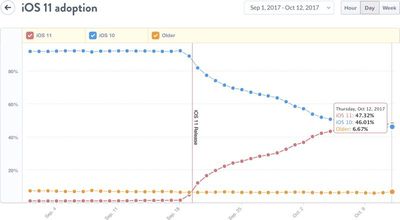
iOS 11 adoption has been much slower than iOS 10 adoption during the same timeframe last year. It took just two weeks for iOS 10 to overtake iOS 9, while iOS 11 was only installed on 38.5 percent of devices at the two week mark.
Adoption rates have been steadily increasing, though. At 24 hours, iOS 11 was installed on 10 percent of devices, and at one week, it was installed on 25 percent.
Apple has released three minor updates to iOS 11 so far to fix bugs and issues discovered since its launch. The most recent update, iOS 11.0.3, came out just yesterday.
The first major update to iOS 11, iOS 11.1, is in the works and that update may spur people running iOS 10 to upgrade to iOS 11. iOS 11.1 introduces new emoji characters, often popular with users, and it reintroduces a 3D Touch gesture that lets the App Switcher be accessed with one hand.
Popular Stories
When the iPhone Duo launched, we shared a list of some of the fun apps developers created for the new form factor. Two weeks out, developers are continuing to come up with fresh ideas, so we thought we'd share some of our favorites.
Games
Marbles Unhinged ($2.99) - Marbles Unhinged is a marble maze designed for the Duo. When you fold it, the floor turns into a ramp. If you stand the top...
Apple is launching five new products on Friday, November 6, following pre-orders that opened last week, including its first touchscreen MacBook Pro models.
The following new products will be available from today:
iPad mini with OLED display and A20 Pro chip
iMac with M6 chip
14-inch MacBook Pro with M6 chip
14-inch MacBook Pro with OLED touchscreen
16-inch MacBook Pro with OLED...
Apple has made a change to its development process for iOS 28, macOS 28, and corresponding software updates, according to Bloomberg's Mark Gurman.
In his Power On newsletter today, he said Apple separates development of each year's new operating systems into three major stages. Typically, he said each stage consists of four weeks of coding followed by a four-week "convergence" period where...