Bloomberg: Apple Silicon Mac Pro May Feature Up to 32 High Performance Cores, 128 Core Option for Graphics - MacRumorsOpen MenuShow RoundupsShow Forums menuVisit ForumsOpen Sidebar
Skip to Content

Bloomberg: Apple Silicon Mac Pro May Feature Up to 32 High Performance Cores, 128 Core Option for Graphics

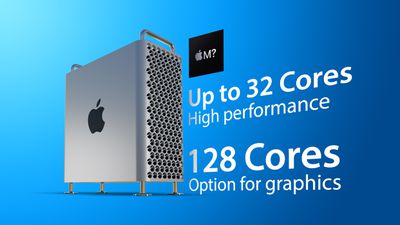
Apple is working on an updated model of its Mac Pro that may feature an Apple silicon chip with as many as 32 high performance cores, and a 128 core option for graphics, according to a new report from Bloomberg's Mark Gurman.
Mac Pro M series feature 1
Bloomberg has reported in the past that Apple is working on an updated Mac Pro that will feature an Apple silicon chip rather than an Intel processor. Today's new report echoes a similar story but offers more details on the performance of this upcoming high-end Mac.

Bloomberg says there are two new Mac Pro models in the works, both featuring a redesign and are planned to "come in 20 or 40 computing core variations, made up of 16 high-performance or 32 high-performance cores and four or eight high-efficiency cores."

Codenamed Jade 2C-Die and Jade 4C-Die, a redesigned Mac Pro is planned to come in 20 or 40 computing core variations, made up of 16 high-performance or 32 high-performance cores and four or eight high-efficiency cores. The chips would also include either 64 core or 128 core options for graphics. The computing core counts top the 28 core maximum offered by today’s Intel Mac Pro chips, while the higher-end graphics chips would replace parts now made by Advanced Micro Devices Inc.

Alongside the faster, more powerful processor, the new Mac Pro will feature a smaller design that "could invoke nostalgia for the Power Mac G4 Cube," according to a previous Bloomberg report. Apple is also working on a successor to the current Mac Pro design that may use Intel processors rather than its own Apple silicon.


Buyer's Guide: Mac Pro (Don't Buy)
Related Forum: Mac Pro

Popular Stories

iPhone Ultra Fold Feature

Foldable iPhone Duo Will Start at $2,000, Won't Launch Until at Least October

Tuesday September 8, 2026 9:45 pm PDT by
Following some recent speculation that Apple could release its foldable phone under the "iPhone Duo" name, it appears that will indeed be the case, according to Bloomberg's Mark Gurman. For months now, the foldable iPhone has generally been referred to as the "iPhone Ultra," even internally, but Apple is apparently going in a different direction for the official name, emphasizing the...
iPhone Ultra Fold Feature

Foldable iPhone Development History and Price Revealed in New Report

Tuesday September 8, 2026 5:55 am PDT by
Former Apple CEO Tim Cook played a major role in the development of the foldable iPhone, which could reach around $3,000 with storage upgrades, according to new details shared by Bloomberg's Mark Gurman. Early in the development of the foldable iPhone, the company reportedly targeted a starting retail price of $1,999, hoping to come under the "potentially controversial $2,000 barrier." The...
airpods pro 3 blue

AirPods With Cameras Were Supposed to Debut Today, Now Delayed

Wednesday September 9, 2026 4:35 am PDT by
Apple planned to introduce high-end in-ear AirPods with built-in cameras for analyzing the surrounding environment at today's event, but the launch has been pushed to next year, Bloomberg's Mark Gurman reports. In early August, Gurman said the earbuds were progressing well enough to potentially ship before the end of the year. By mid-August, though, he reported that Apple had pulled the model...

Top Rated Comments

cmaier Avatar
70 months ago

Why would this type of computer need efficiency cores? Is there something inherent in the design of the CPU which requires them.

I just ask as it seems that the space taken up by the efficiency cores could fit in more performance cores. Really this could be applied to all desktop models. For the Mac Pro they seem the most pointless.
There are many tasks a cpu does that do not require super high performance. Even one of these machines. They go on all the time. Allowing the efficiency cores to do them frees up the performance cores. It also reduces thermal output, allowing the other cores to run hotter. By them being there the overall cpu performance increases. Replacing them with a small number of performance cores (remember the performance cores are MUCH bigger) would actually decrease overall performance.
Score: 26 Votes (Like | Disagree)
70 months ago
So Apple's headless desktop offerings will consist of:

$600 M1 mini with 8 cores.

$x,xxx Mac Pro with 20 or 40 cores.

For the love of pete, can we just get something in the $2,000 range that has 10 or 12 cores?
Score: 15 Votes (Like | Disagree)
70 months ago
I realize it's a niche, but the entire purpose of this design was to provide modular upgrades. It would say a lot to those early adopters of this gen of Mac Pro if Apple offered a $1,000-$1,500 M1X or M2 CPU card that allowed an upgrade without the need to repurchase the entire Mac Pro. I imagine the Mac could dynamically adapt which CPU it would use based on whether the app is optimized for Apple Silicon (and, perhaps, even magically use the MacPro's discreet graphics cards where there was an advantage to doing so). This would allow those users to maintain backward compatibility, Windows compatibility and preserve their investment. It could also be billed as a more "green" upgrade than just a wholesale replacement. Realistically, I don't see that happening, but it would be a cool thing to do.
Score: 14 Votes (Like | Disagree)
cmaier Avatar
70 months ago

Great to hear, but how about a 64 core and 128 core version to really get these machines rocking past AMD.
Unless AMD has a 30-or-so watt part with 20 cores, seems these will already rock past AMD.
Score: 13 Votes (Like | Disagree)
70 months ago
Now thats power....
Score: 11 Votes (Like | Disagree)
GLS Avatar
70 months ago

Holy crap.
Coming from you with your background, I'll take this report as impressive.
Score: 10 Votes (Like | Disagree)