

Students and developers who won the lottery to attend the WWDC 2026 Special Event at Apple Park on June 8 have started receiving their invites.
Apple is holding a WWDC keynote viewing at Apple Park, but space is limited so invites were done on a lottery basis. Apple accepted submissions from those interested in attending until Monday night, and winners are now being notified.
Developers and students who won a spot will take part in an all-day event. The day will begin with the keynote viewing at 10:00 a.m. Pacific Time, followed by the Platforms State of the Union, Apple Park tours, and a dinner. Attendees will be able to connect with Apple engineers and experts.
Current Apple Developer Program members, Apple Developer Enterprise Program members, Apple Entrepreneur Camp alumni, and Swift Student Challenge winners from 2024 to 2026 were eligible to apply, with attendees chosen by random selection.
Apple does not charge a fee for the Apple Park special event, but the company does not cover transportation or lodging. Out-of-state attendees will need to purchase airfare, hotel accommodations, and transportation to Apple Park.
WWDC 2026 will take place from June 8 to June 12. Developers and students not selected to attend the Apple Park event can follow along with WWDC through Apple's developer website and app. Apple plans to share 100+ WWDC sessions that walk through all of the new features, and developers can attend interactive group labs and get one-on-one help from Apple engineers.
App developer Clément Sauvage has designed a set of enamel pins for Apple fans who want to commemorate WWDC 2026 and Apple's 50th anniversary. Sauvage is offering the pins on Kickstarter, and plans to start shipments in May ahead of WWDC.
The pins feature the Apple developer logo, the Apple Intelligence icon, Apple's "spaceship" and rainbow at the Apple Park campus, the entrance to Apple's Infinite Loop campus, the Swift logo, and more. A single pin is available for 10 euros, while a full set of eight WWDC-themed pins is priced at 45 euros.
Sauvage has done enamel pin sets in 2021 and 2024, so this is his third offering. There are some add-on pins from prior years available as well.
Apple often designs its own WWDC pins that are given to developers that attend the WWDC Special Event, but the pins are not available for general purchase.
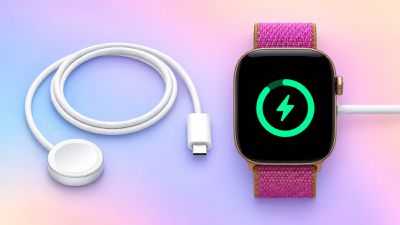
The latest version of Apple's 140W USB-C Power Adapter included with 16-inch MacBook Pro models with the M5 Pro or M5 Max chip has an issue for some.
After the 16-inch MacBook Pro was updated last month, customers in some countries began to notice that Apple's 140W USB-C Power Adapter that comes with it has a subtle design change that breaks compatibility with Apple's Power Adapter Extension Cable.
Specifically, while the charger continues to have a removable plug, Apple has apparently tweaked the design of the underlying male connector with two pins. The connector now has a slimmer pill-like shape, whereas it previously had a modified C7 design. Due to this change, the new charger does not work with Apple's Power Adapter Extension Cable, which still has a female connector designed to match the previous male connector.
The redesigned male connector (on the right in the photo)
Oddly, Apple's product page for the Power Adapter Extension Cable says the cable is compatible with its 140W USB-C power adapters, despite this issue.
Apple's discontinued World Travel Adapter Kit is also incompatible with the version of Apple's 140W USB-C Power Adapter with the redesigned male connector.
The new design has been spotted in Australia and China, but other customers have said their power adapters are not affected, so it is a hit-or-miss situation. We have yet to confirm exactly which countries are impacted by this issue, or if the 140W USB-C Power Adapter that Apple sells separately is affected by this change anywhere.
Anker this week launched a useful new accessory for your desk, debuting the 10-in-1 Nano Power Strip. Priced at $70, the Nano Power Strip has a unique clamp design that puts multiple ports on your desktop while eliminating cable clutter.
I was able to test out the Nano Power Strip ahead of when it launched, and found it to be a useful alternative to standard under-desk power strips. The power strip comes in black or white and it's made of plastic, but the matte finish adds aesthetic appeal, as does a silver front plate for some of the ports.
The clamp is adjustable with an included knob and it fits desktops from 0.6 inches to 1.8 inches. Unfortunately, I have a Parsons-style desk that's too thick to use the power strip as intended, so it's worth measuring. With my thicker desk, I can still attach it to a leg or the back of the desk, but it doesn't put all of the outlets in the ideal position. There are silicone pads at both sides of the clamp to keep furniture from being scratched.
There are two outlets at the top, two outlets at the bottom, and two outlets at the sides, for a total of six outlets. There are two USB-C ports with 70W max charging (split between 45W and 25W when charging two devices), and two 12W USB-A ports. 70W isn't going to charge a MacBook Pro at its maximum speed, but it's enough for day-to-day use, and it'll fast charge most other Apple devices. I do wish there was more USB-C power and one less USB-A port, but it's easy enough to use one of the top outlets to plug in one of Anker's small multi-port power adapters.
With the power strip positioned at the edge of a desk, the two outlets on the top of the device are accessible from the desktop. The four other outlets are accessible from the bottom of the desk, so cables can be hidden away. The USB-A and USB-C ports are also meant to be used from the desktop, and the above-desk portion is slim, coming in at under an inch.
Because the Nano Power Strip attaches to a desk, it stays secure when plugging things in to the ports or the top outlets, which is convenient. I don't need to hold it down to unplug something, and it doesn't move around on a tabletop. If you've ever had a power strip with a bunch of heavy cables plugged in, you probably know what a hassle it can be trying to keep it upright.
The Nano Power Strip is a surge protector, and Anker says that it has overload, short-circuit, and temperature control.
Apple has continued posting short videos featuring its new Little Finder Guy mascot on TikTok and YouTube Shorts, taking advantage of the popularity of the anthropomorphized Mac Finder icon.
The short videos promote the MacBook Neo through a series of Mac tips, all of which include Little Finder Guy in cute poses. A video about journaling features the character with a book and a pen, while another about the Passwords app has Little Finder Guy with a magnifying glass.
Apple has shared nine Little Finder Guy videos this week, and on TikTok, the thumbnails for the videos come together to make a Little Finder Guy mosaic on the Apple TikTok page.
Now that Apple has likely completed its Little Finder Guy image on TikTok, videos with the character could stop or become less frequent, but Apple might opt to keep the mascot around because of how it's caught on.
Apple introduced Little Finder Guy after launching the MacBook Neo in early March, and Apple users immediately liked the character. Stephen Hackett of 512 Pixels created a 3D print version, and Basic Apple Guy has a series of mockups, plus stickers for sale. PCalc's James Thomson also made a set of 5K Little Finder Guy wallpapers.
As of April 1, payment processing is no longer available for purchases made across the App Store and other Apple services in Russia, according to Apple.
In a new support document, Apple said new purchases, in-app purchases, and subscription renewals are no longer available in Russia unless a user already has funds in their Apple Account balance, which can continue to be used.
This change affects the following services and items:
Apple Arcade
Apple Fitness+
Apple Music
Apple Podcasts subscriptions
Apple One
App Store purchases and subscriptions
Apple TV purchases and subscriptions
iTunes Store purchases
iCloud+
Ringtone & Tone purchases
Apple said apps and content that users previously bought will remain available, and it ensured that iCloud data will remain accessible after an iCloud+ subscription ends. More details are available in Apple's support document.
Apple reportedly took this action in response to an order from the Russian government, which allegedly hopes that the lost services revenue from Russian users will pressure the company to add some popular Russian apps back to the App Store, after those apps were removed due to sanctions arising from Russia's war with Ukraine. The order would presumably end if Apple were to make those apps available again.
Note: Due to the political or social nature of the discussion regarding this topic, the discussion thread is located in our Political News forum. All forum members and site visitors are welcome to read and follow the thread, but posting is limited to forum members with at least 100 posts.
When macOS Tahoe and iPadOS 26 launched last September, Apple quietly removed Safari's Compact tab layout – the option that merged the address bar and the tab bar into a single, space-saving row. If you were a fan of it, you will have been out of luck for months.
The good news is that Apple has brought it back. In macOS 26.4 and iPadOS 26.4, the Compact tab bar is once again available as an alternative to the default Separate layout. Here's how to enable it on both platforms.
On Mac
Open Safari.
In the menu bar, click Safari ➝ Settings....
Click the Tabs pane.
Next to "Tabs Layout," select Compact.
The address bar and tab bar will immediately merge into a single row, freeing up vertical screen space.
On iPad
Open the Settings app.
Scroll down and tap through to Apps ➝ Safari.
Under "Tabs," tap Compact Tab Bar.
That's all there is to it. If you decide you prefer the standard layout, simply retrace your steps and select Separate (on Mac) or Separate Tab Bar (on iPad).
The Compact layout can be handy on the smaller screens of the MacBook Air or iPad mini, where every pixel of vertical space counts. It's worth trying if you've never used it, just be aware that tab titles are truncated more aggressively in this view, so when switching between many open tabs you'll have to rely more on favicons than on page names.
Apple today shared a trailer for Widow's Bay, a mysterious new "genre-bending" horror-comedy series set to premiere on Apple TV on Wednesday, April 29.
Widow's Bay is described as a "quaint island town 40 miles off the coast of New England," but apparently "something lurks beneath the surface."
Matthew Rhys stars as Mayor Tom Loftis, who is trying to revive the struggling community.
"There's no Wi-Fi, spotty cellular reception and he must contend with superstitious locals who believe their island is cursed," Apple explains.
"Loftis is determined to build a better future for his teenage son and turn the island into a tourist destination," adds Apple. "Miraculously, he succeeds: tourists are finally coming. Unfortunately, the locals were right. After decades of calm, the old stories that seemed too ludicrous to be true, start happening again."
Apple says Widow's Bay blends genuine horror with character-driven comedy.
The first three episodes in the 10-episode season are set to premiere on Apple TV on Wednesday, April 29, and one additional episode will come out every Wednesday through June 17, with a special two-episode release on Wednesday, May 27. The series is created and executive produced by Katie Dippold, and Hiro Murai directs five episodes this season.
In the U.S., Apple TV is priced at $12.99 per month or $129 per year, with a free one-week trial available for new subscribers. Apple TV is also included in Apple One and Peacock bundles, with all of the options outlined on Apple's website.
You can stream Apple TV in the Apple TV app, which is available on the iPhone, iPad, Mac, Apple TV 4K, Apple Vision Pro, Android, PlayStation, Xbox, Roku, Amazon Fire TV, select smart TVs, on the web at tv.apple.com, and more.
Despite releasing more than 10 new products so far this year, Apple has yet to hold a traditional event with a live-streamed video in 2026.
While anything is possible, our best guess at this point is that Apple's next event will likely be its annual developers conference WWDC in June, with standalone live-streamed Apple Events this April or May currently looking improbable.
Apple then had a busy March, unveiling the iPhone 17e, iPad Air models with the M4 chip, MacBook Air models with the M5 chip, MacBook Pro models with M5 Pro and M5 Max chips, the all-new MacBook Neo, a new Studio Display, a higher-end Studio Display XDR, AirPods Max 2, and Nike Powerbeats Pro 2.
Apple also introduced new color options for select iPhone cases, Apple Watch bands, and the iPhone's Crossbody Strap. The new colors include the likes of Bright Guava, Vanilla, Soft Pink, Clementine, and Electric Lavender.
Announcement Dates
Here is when Apple announced each new product so far in 2026:
AirTag 2: January 26
Black Unity Connection Braided Solo Loop: January 26
iPhone 17e: March 2
New Accessory Colors: March 2
iPad Air with M4 chip: March 2
MacBook Air with M5 chip: March 3
MacBook Pro with M5 Pro and M5 Max chips: March 3
Studio Display (2026): March 3
Studio Display XDR: March 3
MacBook Neo: March 4
AirPods Max 2: March 16
Nike Powerbeats Pro 2: March 17
Rumored Products
Here is what to expect from Apple later this year, according to rumors.
Beyond the usual annual updates to iPhones and Apple Watches, Apple's all-new smart home hub is finally expected to launch later this year, once the more personalized version of Siri arrives. We are also expecting a foldable iPhone, a MacBook Pro with an OLED display, and long-awaited updates to the Apple TV and HomePods this year.
MacBook Pro with OLED display: A major redesign towards the end of 2026, with M6 Pro and M6 Max chips, an OLED display, a touch screen, a Dynamic Island, and a thinner design. On this device, which could also be named MacBook Ultra, macOS 27 is expected to offer a touch-friendly interface.
Home
Apple TV:A17 Pro chip with support for the more personalized Siri, and Apple's N1 chip with Wi-Fi 7 support. A built-in FaceTime camera has been rumored for a future Apple TV, but it is unclear if that will arrive with the next model.
HomePod mini:S9 chip or newer with support for the more personalized Siri, Apple's N1 chip with Wi-Fi 7 support, improved sound quality, a second-generation Ultra Wideband chip, and potentially new color options like red.
Face ID Doorbell: A video doorbell with Face ID and HomeKit Secure Video, wirelessly connects to a compatible deadbolt lock.
Apple Event Timing
As we mentioned above, our best guess at this point is that Apple's next event will likely be its annual developers conference WWDC in June. The reason for this is that very few Apple products if any in the list above are rumored to be launching imminently, with all of the new smart home products and related accessories in particular reportedly held up until the more personalized version of Siri is finally ready later this year. This makes standalone live-streamed Apple Events this April or May seem improbable.
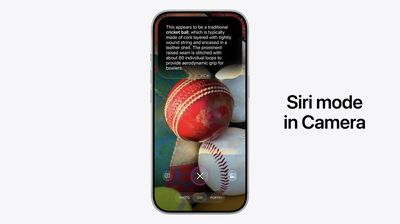
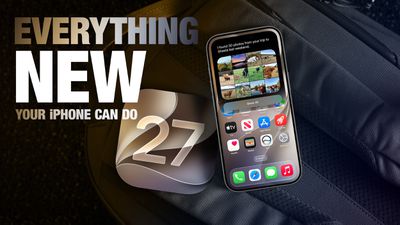
Siri's long-awaited revamp is expected to arrive as part of iOS 27, which should be available in beta starting in June and widely released in September.
The only product in the list above that might arrive before WWDC is an iPad 12 with Apple Intelligence support, but it would have been more fitting for Apple to announce that device alongside the new iPad Air last month, so even the entry-level iPad might not be updated again until the second half of this year.
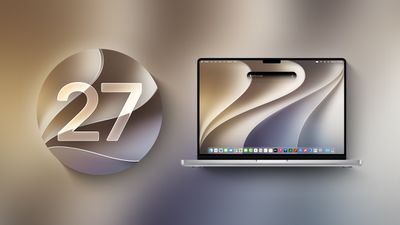
WWDC runs from Monday, June 8 through Friday, June 12 this year. The conference primarily focuses on Apple's latest software platforms, which will include iOS 27, iPadOS 27, macOS 27, watchOS 27, tvOS 27, and visionOS 27 this year, but Apple has also announced new hardware during its WWDC keynote in some years. The last time that happened was at WWDC 2023, when Apple unveiled the Vision Pro, the first 15-inch MacBook Air, Mac Studio models with M2 Max and M2 Ultra chips, and a Mac Pro with the M2 Ultra.
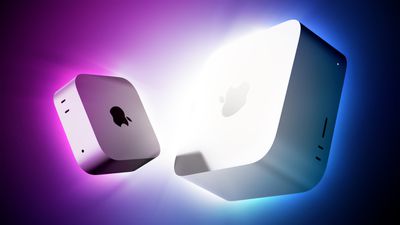
If history repeats itself, the product most likely to be unveiled at WWDC 2026 could be the next Mac Studio, which would be powered by the existing M5 Max chip and an all-new M5 Ultra chip. Apple skipped an M4 Ultra chip, resulting in the current Mac Studio having a mishmash of M4 Max and M3 Ultra chips. This time around, the M5 Ultra chip would not extend to the Mac Pro, as the desktop tower has been discontinued entirely.
Of course, Apple could always surprise us, so stay tuned.
Amazon has introduced a few new record low prices on the new M5 MacBook Air this week, with up to $84 off these notebooks. The biggest markdowns can be found on the 13-inch MacBook Air, but there are still some solid deals on 15-inch models as well.
Note: MacRumors is an affiliate partner with Amazon. When you click a link and make a purchase, we may receive a small payment, which helps us keep the site running.
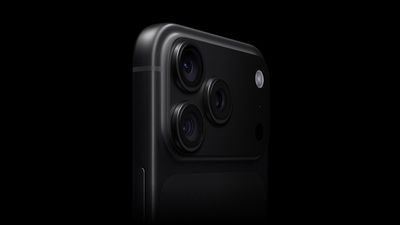
Amazon has the 512GB 13-inch M5 MacBook Air for $1,033.00, down from $1,099.00, and the 24GB/1TB model for $1,415.50, down from $1,499.00. Both of these are only available in Silver and represent new record low prices for each configuration.
In terms of the 15-inch models, you'll find $50 discounts across nearly every configuration of the M5 MacBook Air. Prices start at $1,249.00 for the 512GB model, down from $1,299.00, and also include both 1TB models on sale.
If you're on the hunt for more discounts, be sure to visit our Apple Deals roundup where we recap the best Apple-related bargains of the past week.
Deals Newsletter
Interested in hearing more about the best deals you can find in 2026? Sign up for our Deals Newsletter and we'll keep you updated so you don't miss the biggest deals of the season!
Apple's vice president of fitness technologies Jay Blahnik will retire this summer, bringing to an end a 13-year stint with Apple that was marred by accusations that he created a toxic work environment and sexually harassed an employee.
In an email to employees this week, Apple said Blahnik, 57, will retire in July "to spend time with his family and make an exciting move to New York City," according to The New York Times.
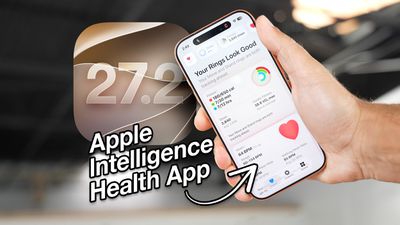
Blahnik joined Apple in 2013 after two decades as a consultant at Nike. He played a central role in developing the Apple Watch's iconic Activity rings (the three colored circles that users close daily by exercising, standing, and burning calories) and later oversaw Fitness+, Apple's subscription workout service featuring video classes for strength work, HIIT, cycling, meditation, yoga, and more.
His leadership of the Fitness+ team however drew serious complaints. In an August 2025 report by the Times, nine current and former employees accused Blahnik of being "verbally abusive, manipulative and inappropriate." More than 10 of the roughly 100 employees on his team had sought extended mental health or medical leaves of absence since 2022, the report said.
Apple settled one complaint alleging sexual harassment by Blahnik and is currently defending him in a separate lawsuit brought by employee Mandana Mofidi, who accused him of bullying. That case is scheduled to go to trial next year.
When employees raised concerns about Blahnik's conduct, Apple initiated an internal investigation and found no evidence of wrongdoing, so Blahnik remained in his role. At the time, Apple spokesperson Lance Lin called the NYT report full of "many inaccurate claims and mischaracterizations," but didn't specify which claims the company disputed.
It's unclear who will succeed Blahnik at Fitness+. Meanwhile, the future of Fitness+ is itself said to be "under review," according to Bloomberg, with services chief Eddy Cue apparently "considering changes" to the service.
Apple Fitness+ launched in 2020. In the U.S., the service costs $9.99 per month or $79.99 per year. Apple Fitness+ is also available as part of the Apple One Premier bundle, with U.S. pricing set at $37.95 per month.
Apple's 20 percent stake in satellite partner Globalstar has become a sticking point in Amazon's reported bid to acquire the company, according to the Financial Times ($).
Amazon is in talks to buy Globalstar in a deal that would value the satellite telecommunications firm at roughly $9 billion, as part of a broader push to compete with SpaceX's Starlink. But Apple's ownership interest – acquired as part of a $1.5 billion investment in 2024 – has required separate negotiations between the two tech giants, the report says.
Under its existing agreement with Globalstar, Apple has access to 85 percent of the company's satellite network capacity for iPhone features including Emergency SOS, Messages via satellite, and Find My location updates. It's unclear how an Amazon acquisition would affect that arrangement.
Apple has not publicly commented on the talks, and no deal has been finalized. Discussions could still fall apart, according to people familiar with the matter who spoke to FT.
Amazon currently has more than 180 satellites in orbit through its own satellite internet program, known as Leo, but that figure is dwarfed by SpaceX's fleet of over 10,000 active satellites. Bloomberg reported in October that Globalstar was exploring a sale and had held early talks with SpaceX.
Apple is working on a series of new satellite connectivity features for the iPhone which will apparently require upgrades to Globalstar's infrastructure. They include Apple Maps via satellite, photos in Messages via satellite, connectivity in indoors environments, satellite over 5G, and a satellite API for third-party apps.
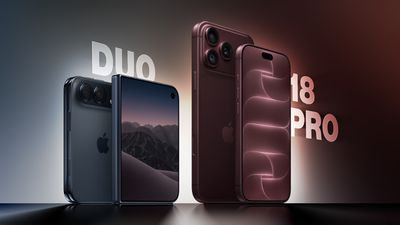
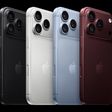
Apple offers the iPhone 17 Pro and iPhone 17 Pro Max in just three colors – Silver, Cosmic Orange, and Deep Blue – but notably there's no black option. Last year was the first time Apple's high-end iPhones have not been available with a black or dark gray color option in any way, but those hoping for the return of black this year for the iPhone 18 Pro should look away now.
According to Weibo-based leaker Instant Digital, Apple won't be offering its next-generation premium models in a black color option. Bloomberg's Mark Gurman has suggested that Apple is testing a deep red finish for the iPhone 18 Pro models, alongside a couple of more traditional color options. But black doesn't appear to be one of them.
It was previously rumored that Apple was also considering purple and brown finishes for the iPhone 18 Pro models, but Gurman has said he believes those color options are "just variants of the same red idea."
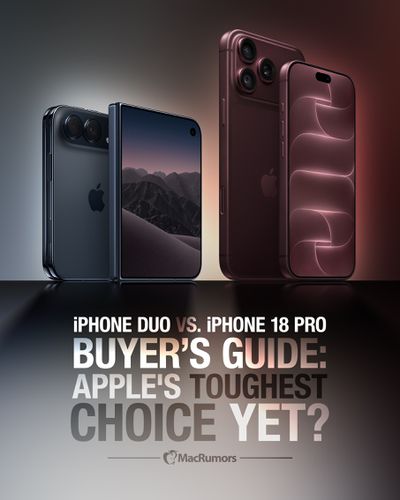
There's better news for anyone planning to buy Apple's rumored foldable iPhone in a more traditional finish. Gurman said Apple plans to "stay away from fun colors" and stick to more conservative space gray/black and silver/white colors.
Instant Digital has a good track record for Apple rumors and has provided some strikingly accurate information ahead of time, such as the imminent launch of 2023's Yellow iPhone 14, as well as the frosted back glass of the iPhone 15 and iPhone 15 Plus.
The iPhone 18 Pro models are expected to launch in September, with the foldable iPhone potentially arriving later in the year.
Cohen and Cook took a look at rare archival materials from the early days of Apple, some of which Cook wasn't even familiar with. Cook said that he had seen a lot of the devices for the first time while preparing for Apple's 50th anniversary.
Items on display included the first patent Apple filed, which was for the Apple II, the original 2001 iPod, early iPhone components and prototypes, the Apple Watch Cook wore on stage when announcing the device, and more.
According to Cook, the launch of the iPhone was his favorite moment at Apple. When asked why, he said it was because a phone was something everyone at Apple was using every day.
We were using that generation's smart phone, and it was such an awful experience. And I love the fact that all of a sudden you had this touch interface, and it worked like your mind worked.
Cook declined to speak on future products, but he suggested Apple's next hit would be something that "finds the intersection of hardware, software, and services." Cook also declined to comment on talk about him retiring. "My answer to that is when the day comes, I'll know it," he said.
Apple celebrated its 50th anniversary with a Paul McCartney concert for employees last night, and today, in addition to speaking with the Wall Street Journal, Cook sent out a heartfelt letter to employees.
Today officially marks Apple's 50th anniversary. And as we've celebrated that milestone this month, I've been reflecting on some powerful words from Steve.
"When you grow up, you tend to get told that the world is the way it is," he said. "But life can be much broader once you discover one simple fact: everything around you that you call life was made up by people that were no smarter than you. You can change it, you can influence it, you can build your own things that other people can use. Once you learn that, you'll never be the same again."
This is the ethos that brought Apple into the world in 1976--and for fifty years, it's what has drawn the smartest, most passionate, most creative and most committed people to this company.
We come here to do the best work of our lives, and to reach beyond what any of us could do alone. To be part of a culture that asks us to stay curious, to collaborate deeply, to demand excellence of ourselves and the people around us, and to believe--genuinely believe--that we can do the impossible.
Across our teams and across generations, we've been united by a simple belief: the future isn't something you wait for. It's something you build. And it is staggering to think of everything we've built together.
Fifty years ago, there was a single computer prototype in a garage. Today, there are 2.5 billion active Apple devices in the hands of people in every corner of the earth - helping them create, communicate, learn and connect in ways that would have seemed unimaginable then.
It's impossible to fully quantify the profound impact this company and its people have had on the world. And it's a truly special thing to do what we do every day, knowing that our work is squarely focused on empowering people and enriching their lives.
Whether you joined this year or have been here for dozens of years, I hope you take a minute to reflect on how much your work means. Thank you.
Thank you for pushing yourselves further than you thought you could go. Thank you for believing in our mission and holding fast to our values. Thank you for dedicating yourself to something so much bigger than any one of us.
As extraordinary as it is to reflect on the past fifty years, what excites me most is what comes next. The opportunities ahead of us are among the greatest we have ever seen - and there's no team in the world better positioned to meet them.
Thank you for everything and here's to the next fifty years.
Apple today updated the Sports app for iPhone to add more 2026 FIFA World Cup content. Soccer fans are now able to view complete tournament groupings and follow their favorite national teams in the app. This is the first 48-team World Cup and a departure from the traditional 32-team format.
Following teams allows Apple Sports users to get real-time score updates and stats, plus there is support for Live Activities for tracking games. Apple says that it's easier than ever for fans to stay up to date on the tournament action when it begins on June 11.
The Apple Sports app lets users follow their favorite teams, tournaments, and leagues, with tools for navigating between scores and upcoming games, viewing play-by-play and lineup details, and tapping into the Apple TV app to watch live events.
Apple Sports includes support for more than 30 of the top soccer leagues and tournaments across North America, Latin America, and Europe.
Apple's final product in (PRODUCT)RED is no longer available, as the iPhone 14 Silicone Case in that color was marked as sold out on its online store last month.
Since 2006, Apple has partnered with the (RED) brand to raise money for The Global Fund, an organization that aims to combat diseases such as HIV/AIDS, tuberculosis, and malaria in Africa. Through this partnership, Apple had long offered a (PRODUCT)RED option for some products, but the color is no longer available at all.
While the (PRODUCT)RED era is over for now, the color could always make a return one day. The upcoming iPhone 18 Pro and iPhone 18 Pro Max will reportedly be available in a "deep red" finish, but this might look more like burgundy than bright red, so it remains to be seen if Apple revives the (PRODUCT)RED brand for that.
(RED) was co-founded by U2 singer Bono, and Apple's partnership with the brand goes back to the Steve Jobs days. Apple continues to support The Global Fund through its annual Apple Pay donation program, which raised $3 million last year. So, PRODUCT(RED) is over for now, but Apple's partnership with (RED) remains alive.
Apple offered a variety of iPod, iPhone, and Apple Watch models in (PRODUCT)RED over the years, with some of the most recent products available in the color being the iPhone SE 3, iPhone 14, iPhone 14 Plus, and Apple Watch Series 9. A variety of iPhone cases, Apple Watch bands, and other accessories also came in the color.
Apple today updated its vintage and obsolete product page to add the Wi-Fi version of the third-generation iPad Air. Cellular iPad Air 3 models were already on the list, but the Wi-Fi models were sold for a longer period of time, and are now just appearing.
The iPad Air 3 was released in March 2019, five years after the prior-generation iPad Air 2. It was a new iPad in Apple's tablet lineup, featuring the same design as the 2017 iPad Pro with 10.5-inch display, A12 Bionic chip, and support for the first-generation Apple Pencil.
It was one of the last iPads to feature a Lightning port and Home button before Apple transitioned to USB-C, an all-display design, and a Touch ID power button. It's also the last version of the iPad Air that featured white bezels around the display.
Apple discontinued the iPad Air 3 in September 2020 with the launch of the iPad Air 4. Some devices had an issue with screen flickering flashing, or dying, leading to a recall program where Apple replaced affected models for up to two years from the purchase date.
Apple adds a product to its "vintage" list when it has been five years since it was last distributed for sale, and then it becomes "obsolete" at the seven-year mark. With vintage products, Apple retail locations and Apple Authorized Service Providers can do repairs if the required parts are available.
Devices that are obsolete are generally not eligible for repair and Apple stops providing repair components.
Earlier this week, Apple added the 13-inch 2017 MacBook Air to its vintage list, and moved the iPad mini 4 and the 32GB Apple TV HD to its obsolete product list.
Apple added the 14-inch MacBook Pro with M5 chip and the iPad 11 to its online store for refurbished products today, allowing customers to purchase like-new models at a discount. The refurbished devices are available in the U.S., Canada, UK, and many other European countries.
Pricing on the 14-inch MacBook Pro with M5 chip starts at $1,359 in the U.S. for the model with a 10-core CPU, 10-core GPU, 16GB unified memory, and 512GB SSD.
Apple has several configurations available at different price points, including a high-end model with 32GB RAM and a 4TB SSD for $2,759. Discounts are right around 15 percent, which is common for refurbished Macs.
As for the iPad 11, refurbished pricing starts at $299 for the base model, which is a $50 discount off of the regular $349 price. Apple has higher tier models with more storage, along with Wi-Fi + Cellular models.
The 14-inch M5 MacBook Pro models came out in October 2025, while the iPad 11 with A16 chip debuted in March 2025.
Refurbished products are sold with the same one-year warranty offered with a new Apple device, plus they come with all manuals and accessories. Apple employs a testing, repair, repackaging, and cleaning process to ensure that refurbished devices are identical to new devices. All refurbished products are eligible for AppleCare+.